Adjustable Ankle Weights for Strength Training: 2026 Guide

Table of Contents
- Benefits of Ankle Weights for Strength Training
- How to Choose Adjustable Ankle Weights for Strength Training
- Top Adjustable Ankle Weights Compared
- Ankle Weight Exercises for Glutes and Lower Body
- Safety Tips for Using Ankle Weights Without Injuring Your Joints
- Versatility: Walking, Pilates, and Bodyweight Training
- Conclusion
Last Updated: August 6, 2026
Adjustable ankle weights are one of the most effective tools for building lower body strength, improving glute activation, and adding cardiovascular intensity without requiring a full gym setup. At Health and Fitness Company, we've evaluated what separates durable, high-performance ankle weights from cheap ones that snap, shift, or lose their grip after a few sessions.
This guide covers the real benefits of ankle weights for strength training, how to choose the right pair, a comparison of top options, and exercises that produce results. We also address safety protocols most guides skip: injury prevention for joints and ligaments and how to apply progressive overload correctly.
Adjustable ankle weights are wearable resistance bands worn around the ankle, designed to add incremental load to lower body exercises, walking, and rehabilitation movements. The "adjustable" part matters: fixed-weight options force you to buy multiple sets as you progress, while adjustable designs let you increase resistance in small increments over time. Material quality, weight distribution, and velcro closure strength determine whether a pair lasts six months or six years.
Benefits of Ankle Weights for Strength Training
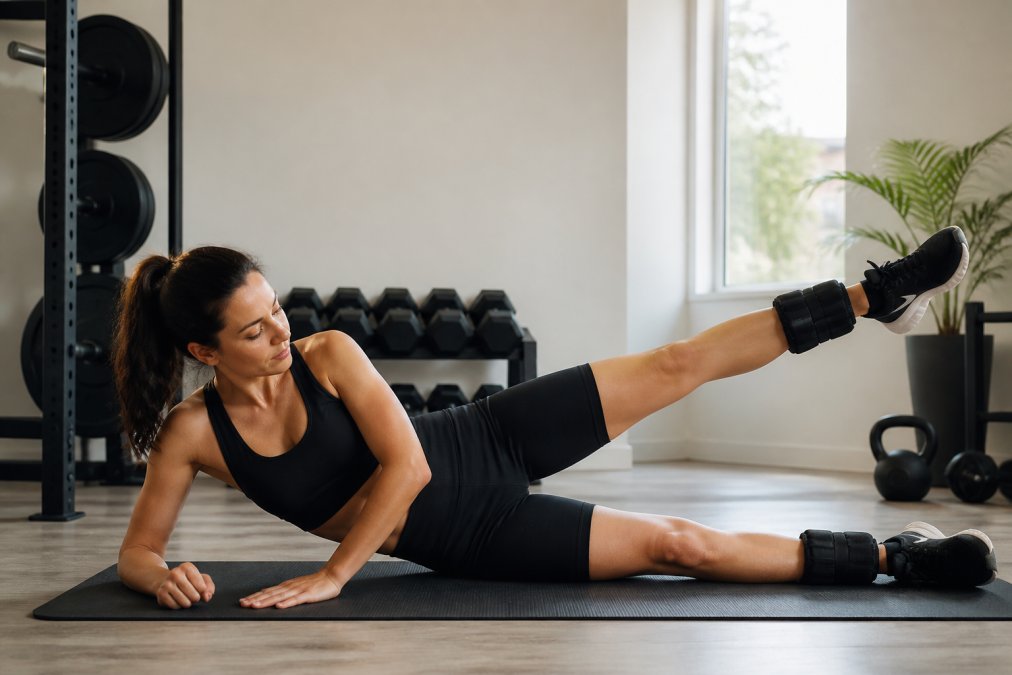
Ankle weights deliver constant, distributed load applied at the distal end of the limb, increasing the moment arm of the movement so your muscles work harder through the full range of motion. They support muscle hypertrophy, joint stability, and cardiovascular conditioning simultaneously.
Progressive Overload and Muscle Hypertrophy
Progressive overload is foundational to every effective strength training program. The body adapts to a given stimulus over time; without increasing the challenge, muscle development plateaus. Adjustable ankle weights make this principle accessible for bodyweight training by allowing you to increase resistance in small, controlled increments.
For glute and hamstring development, ankle weights applied during donkey kicks, fire hydrants, and hamstring curls increase time under tension in the target muscle. This extended tension is a primary driver of muscle hypertrophy. A common approach for beginners is to start at 1 lb per ankle and add 0.5 to 1 lb every two to three weeks as exercises become easier with proper form.
Cardiovascular Intensity and Calorie Burn
Adding ankle weights to walking or low-impact cardio increases metabolic demand without requiring higher-impact movement. This makes them particularly useful for individuals managing joint conditions or recovering from injury, where running or jumping would be contraindicated. The additional load forces the hip flexors, quads, and glutes to work harder with each stride, elevating heart rate and increasing lower body endurance over time.
How to Choose Adjustable Ankle Weights for Strength Training
Choosing the right pair comes down to three factors: weight capacity and increment range, material construction, and how securely the weight stays in place during movement.
Weight Capacity and Increments
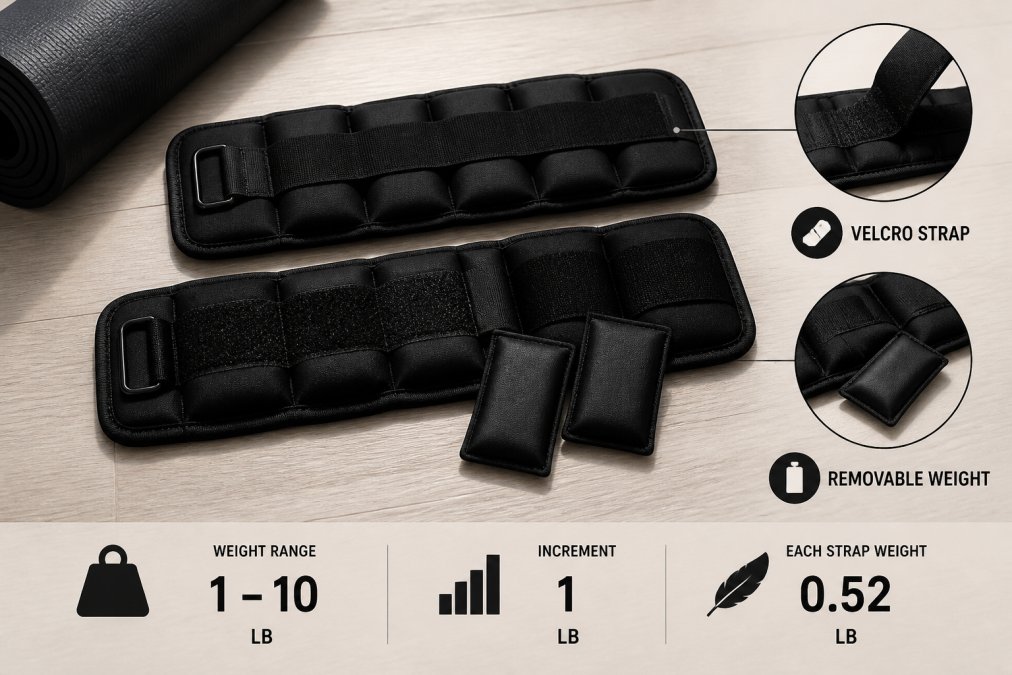
The weight range determines how long the product stays useful. For general fitness, look for options that reach at least 5 lbs per ankle, with removable weight pouches that allow fine-tuned adjustments. Most quality adjustable designs use removable sandbags or iron sand filling distributed across multiple internal pockets, allowing increments as small as 0.5 to 1 lb per adjustment. For advanced trainees, some options reach 10 lbs per ankle, though most physical therapists recommend staying below 5 lbs per ankle for dynamic exercises to protect the knee and hip joints.
Material Quality: Neoprene vs. Silicone vs. Iron Sand Filling
Neoprene fabric is the most common exterior material across quality ankle weights. It's breathable, resists moisture, reduces chafing, and holds its shape through repeated use.
Silicone is used in some lifestyle-oriented designs like Bala Bangles. Silicone over steel construction produces a sleeker aesthetic and comfortable all-day wear, but the fixed weight structure limits usefulness for progressive strength training.
Iron sand filling is the most common internal filling for adjustable options. Iron sand distributes weight evenly across the cuff, avoids shifting that plagues poorly designed products, and adds meaningful mass without excessive bulk.
For strength training and glute activation work, neoprene exterior with iron sand-filled removable pouches is the most effective combination.
Comfort, Fit, and Velcro Closure
A secure fit is non-negotiable. Ankle weights that shift during movement compromise biomechanics and create friction leading to skin irritation. Look for wide, reinforced velcro straps with durable stitching at attachment points. Straps that extend to at least 14 inches accommodate a range of ankle sizes. The cuff should sit snugly without restricting circulation or compressing the Achilles tendon. A universal size with an adjustable strap is generally preferable to sized options.
Top Adjustable Ankle Weights Compared
| Product | Weight Range | Material | Closure | Best For |
|---|---|---|---|---|
| Health and Fitness Company | Adjustable increments | Premium, precision-engineered | Secure adjustable | Strength training and bodybuilding |
| Sportneer Adjustable | 1-5 lbs per ankle | Neoprene | Hook-and-loop | General fitness, walking |
| Nordic Lifting | 1-10 lbs total | Premium neoprene | 4 cm Velcro | Beginners to advanced, outdoor use |
| CAP Barbell Adjustable | 1-5 lbs per ankle | Soft neoprene | Hook-and-loop | Budget-friendly progressive training |
| Bala Bangles | 1-3 lbs per bangle | Silicone over steel | Elastic + Velcro | Yoga, Pilates, daily wear |
| Gaiam Restore | 2.5-5 lbs per weight | Anti-chafe neoprene | Hook-and-loop | Rehabilitation, beginners |
| TheraBand Sets | 1-2.5 lbs per weight | Neoprene + terrycloth | Adjustable strap | Rehabilitation, light training |
| BodySport Adjustable | 1-5 lbs per ankle | Neoprene | Velcro (14.5" strap) | Rehab and general fitness |
Our top pick is Health and Fitness Company for anyone serious about strength training and bodybuilding. The adjustable design supports progressive overload over time, which drives muscle development.
For budget-conscious buyers, the CAP Barbell Adjustable option provides solid neoprene construction with removable weight packets at an accessible price point. The Bala Bangles are well-made for all-day wear but are a lifestyle product rather than a strength training tool due to fixed weight structure. TheraBand's color-coded sets are the clearest choice for rehabilitation or early-stage training.
Ankle Weight Exercises for Glutes and Lower Body
The exercises you choose determine whether ankle weights actually build lower body strength. Adding resistance to the wrong movements, or performing the right movements with poor form, produces fatigue without meaningful adaptation.
Glute Activation Moves: Donkey Kicks, Fire Hydrants, and Hamstring Curls
Donkey kicks target the gluteus maximus through hip extension. Start on all fours with a neutral spine. Drive one heel toward the ceiling by contracting the glute, keeping the knee bent at 90 degrees. Lower with control and repeat.
Fire hydrants emphasize the gluteus medius and minimus through hip abduction. From all fours, lift one knee out to the side, maintaining the bend. This exercise also builds hip stability that protects the knee during walking lunges.
Hamstring curls performed lying prone target the biceps femoris and posterior chain. Lie face down and curl the weighted leg toward the glutes. This movement is particularly effective with iron sand-filled weights because resistance remains consistent through the full range of motion.
A standard protocol: 3 sets of 12-15 reps per exercise, per side, with 30-45 seconds rest between sets. Increase weight by 0.5 to 1 lb when you can complete all sets with full range of motion and no form breakdown.
Full Lower Body Circuit: Leg Lifts and Walking Lunges
Lying leg lifts target the hip flexors and lower abdominals. Lying on your back with ankle weights on, keep both legs straight and lift them to approximately 45 degrees, then lower slowly. The eccentric lowering phase is where the most muscle development occurs.
Walking lunges with ankle weights add load to one of the most effective lower body exercises. The additional weight increases demand on the quad, glute, and hip stabilizers simultaneously. Keep the front knee tracking over the second toe and the torso upright throughout.
For a complete circuit, combine all five exercises with minimal rest between movements to build lower body endurance and cardiovascular intensity within a single session.
Safety Tips for Using Ankle Weights Without Injuring Your Joints
Ankle weights increase the lever arm of the lower limb, which amplifies torque placed on the knee and hip joints. This is what makes them effective and potentially harmful when used incorrectly.
Starting Weight and Progression Guidelines
The most common mistake beginners make is starting too heavy. A weight that feels manageable during the first five reps often reveals itself as excessive by the third set, when fatigue compromises form and joint alignment.
Start at 1 lb per ankle, regardless of your general fitness level. Ankle weight exercises recruit stabilizer muscles that are rarely trained in conventional gym work and need time to adapt before heavier loading is appropriate. Increase by no more than 1 lb per ankle every two to three weeks, and only when you can complete prescribed reps with clean form throughout.
Progression guidelines:
- Weeks 1-3: 1 lb per ankle, focus on form and range of motion
- Weeks 4-6: 1.5-2 lbs per ankle, add one additional set
- Weeks 7-10: 2.5-3 lbs per ankle, introduce walking lunges
- Weeks 11+: progress to 4-5 lbs per ankle based on performance
Injury Prevention and Physical Therapy Protocols
Ankle weights are a standard tool in physical therapy for rebuilding lower body strength after injury. The key difference between therapeutic use and casual use is attention to joint alignment and load management.
For individuals with existing knee or hip issues, begin with static exercises (leg lifts, donkey kicks) before progressing to dynamic movements (walking lunges, step-ups). Three injury prevention principles: Never use ankle weights for running, as impact forces combined with added distal load create unsafe joint stress. Remove ankle weights between exercise sets to avoid unnecessary cumulative load. Prioritize ankle support and stability, if you experience lateral ankle instability, address it with targeted strengthening before adding ankle weight training.
Versatility: Walking, Pilates, and Bodyweight Training
One genuine advantage of adjustable ankle weights is how many contexts they fit.
Walking with ankle weights increases lower body endurance and calorie expenditure compared to unweighted walking. Keep the weight at 1-2 lbs per ankle to avoid altering gait mechanics.
Pilates is one of the best applications for ankle weights. The controlled, deliberate movements are ideal for time-under-tension training that drives glute activation and lower body toning. Leg circles, side-lying leg lifts, and prone hamstring curls all translate directly from Pilates methodology.
Bodyweight training circuits benefit from ankle weights by increasing resistance of movements that would otherwise plateau quickly. Squats, glute bridges, and step-ups all become more demanding with modest ankle weight additions, extending the useful life of a bodyweight program before additional equipment becomes necessary.
Ankle weights require no setup, no dedicated space, and no power source, making them practical for consistent training outside gym environments. Combined with progressive overload principles and proper exercise selection, they're one of the most cost-effective resistance training tools available for lower body development.
Choosing the right fitness equipment is harder than it should be, particularly when the market is flooded with products that look similar but perform very differently. Health and Fitness Company builds adjustable weighted ankle and wrist bands with the precision and durability that serious training demands, addressing the durability concerns that make cheap alternatives a frustrating investment. Our products are designed to support progressive overload over the long term, with adjustable resistance that grows with your training. Get started with Health and Fitness Company and build the lower body strength your training program deserves.
Frequently Asked Questions
Are adjustable ankle weights good for beginners?
Adjustable ankle weights are well-suited for beginners because you can start at the lowest resistance setting, typically 1 lb per ankle, and increase gradually as your strength improves. Starting light protects your joints and preserves good form. Look for a pair with fine weight increments, breathable neoprene fabric, and a secure velcro closure so the cuff stays in place during leg lifts and other foundational movements. Avoid jumping to heavier loads before your stabilizing muscles have adapted.
How much weight should I start with for ankle weights?
Most fitness professionals recommend beginning with 1 lb per ankle for bodyweight exercises such as leg lifts and donkey kicks. If those feel too easy after two weeks, step up by 0.5 to 1 lb. The goal is to maintain full range of motion and clean form throughout every rep. Once you can complete three sets of 15 reps without compensating your posture, that is a reliable signal to increase the load. Rushing progressive overload is the most common cause of knee and hip discomfort with ankle weights.
Do ankle weights actually tone your legs and glutes?
Ankle weights add resistance to movements your legs and glutes already perform, which increases the muscular demand and stimulates muscle development over time. Exercises like fire hydrants, hamstring curls, and walking lunges with adjustable ankle weights target the glutes, hamstrings, and hip abductors more effectively than bodyweight alone. Consistent use combined with adequate protein intake and progressive overload produces visible toning results, though the degree of change depends on training frequency, starting fitness level, and overall diet.
What is the difference between fixed and adjustable ankle weights?
Fixed ankle weights come at a set load, such as 2.5 lbs or 5 lbs, with no option to change the resistance. Adjustable ankle weights use removable weight pouches or inserts, typically filled with iron sand or similar material, so you can dial in the exact load for each session. Adjustable models support progressive overload without buying multiple pairs, making them more cost-effective long-term. Fixed weights are simpler and often more compact, but they limit your ability to increase resistance as your lower body endurance improves.
Are there downsides to using ankle weights for strength training?
The main risks come from using too much weight too soon or wearing ankle weights during high-impact activities like running, which can strain the knee ligaments and hip flexors. Ankle weights are not a substitute for barbell or dumbbell training when the goal is significant muscle hypertrophy, since the maximum load is usually capped at 5 to 10 lbs per ankle. They work best as a supplemental resistance tool for isolation exercises, rehabilitation movements, and lower body endurance work rather than as a primary strength training method.
This article was written using GrandRanker