Adjustable Resistance Bands vs Free Weights: 2026 Guide

Table of Contents
- Adjustable Resistance Bands vs Free Weights: The Core Differences
- How to Progress with Resistance Bands
- Resistance Band vs Dumbbell Muscle Growth
- Benefits of Weighted Wrist and Ankle Bands
- Joint-Specific Biomechanics and Injury Risk
- Hybrid Training Protocols and Long-Term Costs
- Conclusion: Which Setup Fits Your Goals?
- Frequently Asked Questions
Last Updated: October 3, 2026
Adjustable Resistance Bands vs Free Weights: The Core Differences
The adjustable resistance bands vs free weights debate comes down to one variable: how each tool loads your muscles through a range of motion. The honest answer is that bands win on portability and joint-friendly tension, while free weights win on measurable progressive overload and maximal strength.
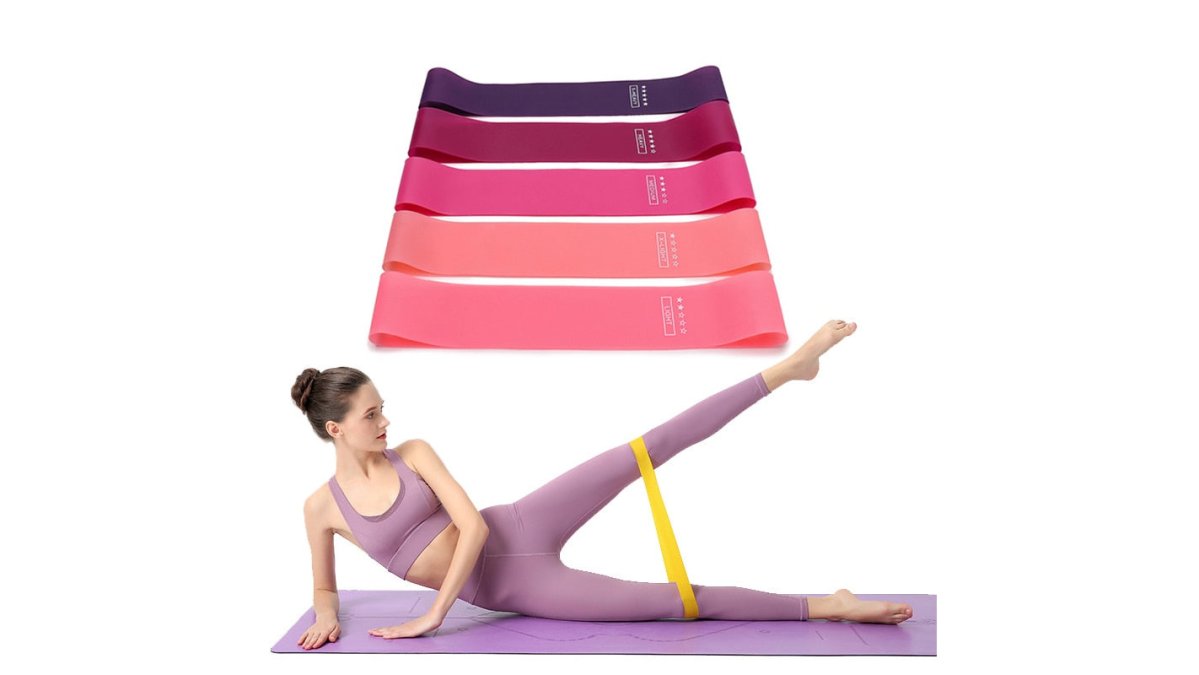
Here is the distinction that matters most: resistance bands generate variable resistance, meaning tension increases as the band stretches, while free weights provide constant resistance through the entire movement.

Variable vs. Constant Resistance Explained
Variable resistance is a loading pattern where the force required to move the implement changes as you move through the range of motion. A band is easiest at the start of the stretch and hardest at full extension.
This changes your resistance profile. With free weights, the hardest point is usually mid-range, where your joint angle gives you the least use. With bands, the hardest point is the end range, where the band is most stretched. Neither is universally better. Bands suit lockout strength and explosive work.
Portability and Space Efficiency
No contest here: bands win. Our Rubber Resistance Band Set with Door Anchor, Ankle Strap, Exercise Chart, and Resistance Band Carrying Case covers five resistance levels from 2-4 lbs up to 25-30 lbs in one case.
Free weights demand floor space, a rack, and often a spotter. Adjustable dumbbells shrink that footprint considerably, but a pair still weighs what it weighs. If you train in a small apartment or travel weekly, bands are the practical choice.
How to Progress with Resistance Bands
Progression with bands follows the same principles as any strength program, but you adjust different levers. Instead of adding plates, you change band tension, stretch length, tempo, or use.
Here is how to progress with resistance bands in a structured way:
- Step up band tension. Move from a light band to a heavier one when you can complete the top of your rep range with clean form.
- Increase stretch. Anchor the band further away or step wider to lengthen it at the start position.
- Slow the eccentric phase. Take three to four seconds to return to the start. This raises time under tension without changing the band.
- Add a pause at peak tension. Hold the fully stretched position for two seconds.
- Stack bands. Combine two bands for a heavier resistance profile.
- Reduce use. Switch from a two-arm to a one-arm variation of the same movement.
Resistance Band vs Dumbbell Muscle Growth
Resistance band vs dumbbell muscle growth is closer than the gym-floor folklore suggests, but the mechanisms diverge in ways that matter for program design. Both create mechanical tension, the primary driver of hypertrophy, as long as the load is sufficient and you train close to failure. The difference is how that tension is distributed and how easily you can quantify it.
Muscle Activation and Hypertrophy
Studies comparing band and free-weight training generally find similar muscle activation when loads are matched for effort. The catch is that bands make it harder to quantify load.
The deeper issue is the strength curve. A dumbbell delivers peak resistance at your mechanically weakest joint angle, usually mid-range, which is exactly where muscle damage and growth stimulus concentrate.
Where bands fall short: heavy compound movements.
Rep Ranges and Load Matching
A practical rule most coaches use: bands work best in the 12-30 rep range, where metabolic stress and time under tension carry more of the growth stimulus. Free weights dominate the 3-8 rep range, where absolute load drives neural adaptation and myofibrillar hypertrophy.
To match effort between tools, use Reps in Reserve (RIR) rather than a fixed weight. Stop a band set when you have one to two clean reps left, the same way you would with a dumbbell.
Practical Hypertrophy Setup
If muscle growth is the goal, structure band work around the following:
- Anchor low for pressing and squatting patterns so the band is already stretched at the start position, giving you tension through more of the range.
- Use a two-second pause at peak tension on every working set to extend time under tension without adding load.
- Pair a band with a dumbbell on the same movement (band around the back, dumbbell in hand) to fill in the weak portion of the strength curve. This is the core idea behind accommodating resistance.
- Log reps and RIR, not pounds, so you can track progression across sessions.
American Council on Exercise resistance training guidelines
Benefits of Weighted Wrist and Ankle Bands
Weighted wrist and ankle bands add load to bodyweight movements without changing your grip or your setup. They are a supplement to bands and free weights, not a replacement for either.
The benefits of weighted wrist and ankle bands come down to three things:
- Added resistance on bodyweight work. Push-ups, dips, planks, and leg raises get harder without adding a barbell.
- Grip-free loading. Your hands stay free, which matters for pull-ups and carries.
- Adjustable progression. You add or remove weight in small increments rather than jumping to the next dumbbell.
For beginners, the key is starting light. Adding weight to your wrists and ankles before your form is stable will throw off your balance and reinforce bad movement patterns. Master the unweighted version first.
Joint-Specific Biomechanics and Injury Risk
Here is where most comparisons get lazy. The joint stress profile of a band and a dumbbell is genuinely different, and it changes which tool suits which joint.
FIXTECH Adjustable Dumbbell Set 20/30/50/70lbs Free Weight Set with Connector 4 →
A band's tension peaks at the end range, which is often the position where a joint is most vulnerable under heavy external load.
Free weights load the joint most heavily at the mechanically weakest point, usually mid-range. This builds resilience in that range but also concentrates stress there.
Rehabilitation and Stabilizer Muscle Engagement
Bands have a long history in physical therapy, and the reason is straightforward: the resistance is self-limiting. If a movement hurts, the band gives, and you can back off without dropping a weight.
Stabilizer muscles get a different kind of work with bands. Because the band pulls in a fixed direction and the tension changes, your joint has to constantly adjust. That is a real training stimulus, and it is one reason bands show up in functional training and injury prevention programs.
American Council on Exercise guide to resistance training
Hybrid Training Protocols and Long-Term Costs
The smartest approach is not choosing a side. It is sequencing both tools inside one program, and then understanding what each actually costs you over years rather than at checkout. Most comparisons stop at the sticker price. That is the wrong number.
Hybrid Training Protocols
A simple hybrid protocol that uses each tool where it wins:
| Block | Primary Tool | Purpose | Frequency |
|---|---|---|---|
| Warm-up | Bands | Activation, joint prep | Every session |
| Main lift | Free weights | Heavy compound strength | 2-3x per week |
| Accessory | Bands | Isolation, peak tension | 2-3x per week |
| Finisher | Bands + bodyweight | Metabolic stress | 2x per week |
The more advanced version is accommodating resistance: attach a band to a barbell or dumbbell so the band adds tension at the top of the lift while the weight handles the bottom. This fills in the strength curve, loading the mid-range with iron and the lockout with band tension. It is the single best argument for owning both tools, and it is the technique most band-vs-weight articles skip entirely.
A practical weekly template:
- Day 1: Barbell or dumbbell squat, then banded leg extensions and banded hamstring curls.
- Day 2: Dumbbell bench press, then banded chest fly and banded triceps pressdown.
- Day 3: Pull-ups with a band for assistance or added resistance, then banded rows and banded face pulls.
- Day 4: Banded conditioning circuit, squats, rows, presses, and carries for time.
Long-Term Cost: A Total Cost of Ownership View
This is where the comparison usually falls apart. Bands are cheaper to start, but they are a consumable.
Free weights are a capital purchase. A quality adjustable dumbbell set, a barbell, or a set of plates does not wear out under normal use.
A rough 10-year picture, using typical U.S. home-gym pricing:
- Bands only: Low upfront cost, but repeated replacement of snapped or stretched bands. Expect to rebuy the set multiple times.
- Adjustable dumbbells only: Higher upfront cost, near-zero replacement cost, but limited to the load range you buy.
- Hybrid: Highest upfront cost, lowest long-run cost per training session, and the only setup that covers both strength and portability needs.
Our Strength Resistance Band is $15.64, and the Fitness Resistance Band is $37.93, cheap enough that replacing them every year or two is still economical.

For a home gym that needs to cover both, our FIXTECH Adjustable Dumbbell Set at $227.74 converts between dumbbells, a barbell, kettlebells, and a push-up stand.

Conclusion: Which Setup Fits Your Goals?
If your goal is maximal strength on the big compound lifts, free weights are not optional. If your goal is portability, joint-friendly loading, and a training tool that fits in a backpack, bands win outright.
At Health and Fitness Company, we build gear for exactly that approach: precision-engineered, adjustable equipment designed to hold up under real training. Our resistance bands and adjustable dumbbell sets are designed to work together, not compete. Get started with Health and Fitness Company and build a home gym that covers every training goal.
Frequently Asked Questions
Are resistance bands just as effective as free weights for muscle hypertrophy?
Research on muscle activation shows that resistance bands can produce similar hypertrophy to free weights when training volume and effort are matched. The key difference is the resistance profile: bands increase tension as you stretch them, while free weights provide constant tension. You can build muscle with either, but free weights offer more precise loading for progressive overload, especially for heavy compound movements like squats and bench presses.
How do I determine the weight equivalent of a resistance band?
Resistance bands are rated by the tension they create at a specific elongation, not by a direct weight equivalent. A band labeled 25-30 lbs produces that much force when stretched to its recommended length. Because tension changes throughout the range of motion, you cannot directly convert it to a dumbbell weight. Instead, use the rating as a guide and adjust your starting position or band thickness to match the difficulty you want.
Can you combine resistance bands and free weights in a single workout routine?
Combining both is one of the most effective hybrid training protocols. Use free weights for heavy compound lifts like squats, deadlifts, and bench presses to build raw strength. Then add resistance bands for accessory work, accommodating resistance on barbell lifts, or joint-friendly isolation exercises. This approach lets you train stabilizer muscles with bands while still loading heavy with weights, covering both constant and variable resistance in one session.
Which equipment is better for joint health and rehabilitation?
Resistance bands typically win for rehabilitation and joint health because the variable resistance matches your strength curve. As you move into a stronger joint angle, the band provides more tension; at weaker angles, tension is lower. This reduces joint stress at vulnerable points. Free weights apply constant load regardless of joint angle, which can aggravate injuries. Many physical therapists prescribe bands for early-stage rehab before progressing to free weights.
What are the long-term maintenance costs of each option?
Resistance bands wear out over time, especially latex bands exposed to heat or sunlight. Expect to replace them every 6 to 12 months with regular use, which adds up over years. Free weights are a one-time purchase that can last decades with minimal care. However, adjustable dumbbell sets cost more upfront. If you want to minimize long-term spending, free weights have the lower total cost of ownership.