Adjustable Weighted Bands for Home Workouts: A 2026 Guide

Table of Contents
- What Makes Adjustable Weighted Bands Different From Other Resistance Equipment
- Resistance Levels and Weight Ranges: Finding Your Starting Point
- Material Durability and Construction: Anti-Snap Technology and Tensile Strength
- How to Use Weighted Bands for Bodybuilding and Muscle Development
- Benefits of Weighted Bands for Cardio and Full-Body Conditioning
- Top Strength Training Equipment Set Options for Home Gyms
- Safety, Portability, and Maintenance for Long-Term Use
- Conclusion
Last Updated: August 17, 2026
What Makes Adjustable Weighted Bands Different From Other Resistance Equipment
Adjustable weighted bands offer distinct advantages over traditional dumbbells: they scale resistance without buying multiple sets and compress into a gym bag, ideal for space-limited home workouts.

Unlike dumbbells that create constant tension, bands create variable resistance. As you stretch the band, resistance increases, forcing muscles to work harder at end range of motion where you're strongest, where muscle hypertrophy happens. Bands also allow functional movements that dumbbells complicate. A band curl lets your wrist rotate naturally, reducing joint stress and benefiting lifters with shoulder or elbow limitations.
Portability is transformative: a complete set weighs under five pounds and fits in a backpack, compared to 50+ pounds of dumbbells covering the same resistance range. For home training, travel, or alternating locations, bands eliminate friction.
Premium bands use natural latex or synthetic rubber with reinforced stitching and anti-snap technology. Cheap bands snap under tension, creating injury risk. Material quality is non-negotiable.
Resistance Levels and Weight Ranges: Finding Your Starting Point
The right resistance depends on your strength and goals. Most quality bands come in color-coded tiers, light, medium, heavy, and extra-heavy, each representing specific resistance ranges. Light bands offer 5-15 pounds of tension, while heavy bands reach 50+ pounds at full extension.
Beginners should start with light to medium resistance. Proper form beats heavy weight every time. A light band lets you master movement patterns, build neuromuscular connections, and prepare joints for progressive overload.
Progressive overload, gradually increasing tension over weeks and months, drives muscle growth. With adjustable weighted bands, you progress by adding a second band, upgrading to heavier resistance, or increasing repetitions and sets. The Health and Fitness Company's Adjustable Weighted Fitness Wrist and Ankle Band ($91.03) lets you customize tension by adjusting how much of the band you're using, providing finer control than fixed-weight options.
Intermediate lifters benefit from medium to heavy bands for compound movements like banded squats, deadlifts, and chest presses. Advanced lifters often stack multiple bands to reach extreme resistance rivaling heavy dumbbells.
The key insight: resistance level matters less than consistency and form. A lighter band used with perfect technique for three months beats a heavy band used with sloppy form. Start conservatively, master the movement, then progress.
| Resistance Level | Typical Range | Best For | Starting Point |
|---|---|---|---|
| Light | 5-15 lbs | Beginners, rehabilitation | Joint mobility, form work |
| Medium | 25-40 lbs | Intermediate lifters | Compound movements, muscle building |
| Heavy | 40-60+ lbs | Advanced lifters | Lower body, strength focus |
| Extra-Heavy | 60+ lbs | Stacked bands | Maximum tension, peak strength |
Material Durability and Construction: Anti-Snap Technology and Tensile Strength
Band failure happens without warning. Quality construction prevents this through material selection and design.
Natural latex offers superior tensile strength compared to synthetic rubber but degrades faster in sunlight and sweat. Synthetic options last longer in harsh conditions. The best bands use a hybrid approach: a latex core wrapped in neoprene padding for durability and comfort.
Anti-snap technology involves reinforced stitching, layered construction, and sometimes an inner mesh that catches the band if the outer layer tears. Health and Fitness Company's Portable Pilates Bar and Resistance Band ($51.65) includes a metal anti-break pipe that prevents snapping during intense use.
Neoprene padding distributes pressure across a wider surface, letting you focus on movement instead of pain, and protects the band's core from sweat and friction.
Reputable manufacturers test bands by cycling them thousands of times under load. Bands surviving 10,000+ cycles represent genuine quality; cheap bands fail at 500-1,000 cycles.
Quality bands use textured surfaces or rubberized grips that stay stable even when wet, preventing dangerous hand position shifts mid-movement.
How to Use Weighted Bands for Bodybuilding and Muscle Development
Muscle development requires tension, time under tension, and progressive overload. Weighted bands deliver all three when used correctly.
Start with compound movements: banded squats, deadlifts, chest presses, and rows. These recruit multiple muscle groups simultaneously, triggering maximum growth stimulus.
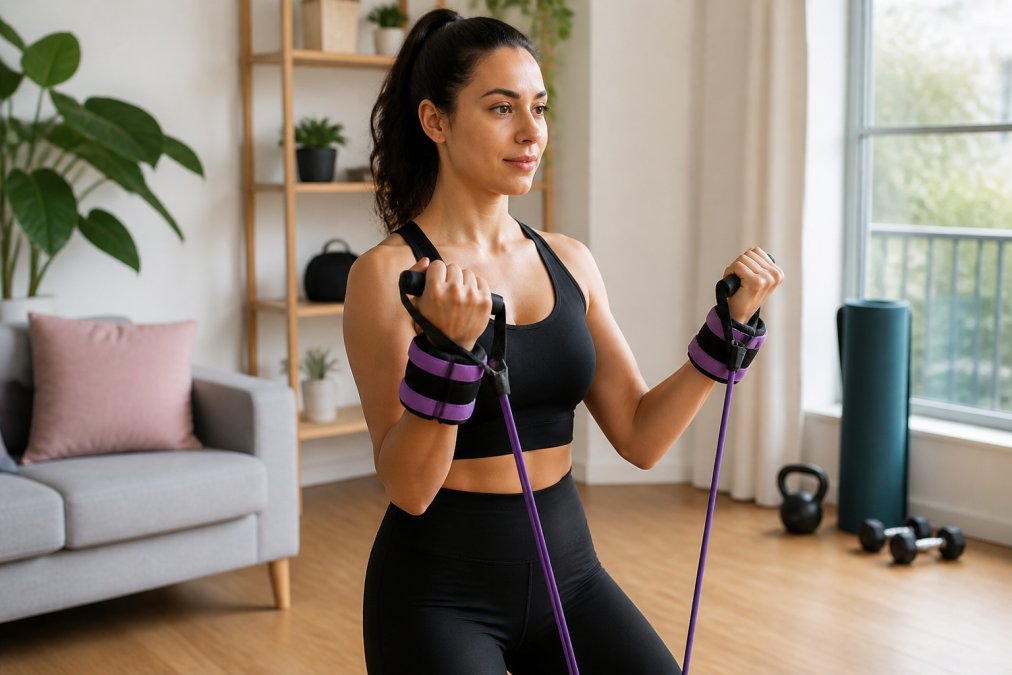
The eccentric phase, lowering the weight, is where most growth happens. With bands, this phase is hardest because resistance increases as you extend, creating maximum tension where muscles are strongest. Take 2-3 seconds to lower, pause briefly, then press back up.
Isolation exercises follow compounds. After fatiguing primary movers with squats and presses, isolation work targets specific muscles for additional volume. Banded bicep curls, lateral raises, and leg extensions use lighter resistance but higher repetitions (8-15 reps per set).
Volume matters more than intensity for muscle growth. Three sets of 10 reps with a medium band builds more muscle than one set of 3 reps with a heavy band. Beginners should aim for 9-12 sets per muscle group per week; intermediate lifters, 12-18 sets; advanced lifters, 18-24 sets.
Rest 2-3 minutes after heavy compounds for ATP recovery; 60-90 seconds after isolation work.
Track workouts: note band color, reps, sets, and feel. When you hit target reps for all sets, upgrade to a heavier band or add another band to the stack.
Benefits of Weighted Bands for Cardio and Full-Body Conditioning
Weighted bands amplify cardio workouts and full-body conditioning by adding resistance to dynamic movements.
Running with ankle weights increases calorie expenditure and challenges your cardiovascular system harder. Studies on weighted vests show athletes burn more calories and improve aerobic capacity faster when training with added load.

Full-body conditioning circuits combine bands with bodyweight movements. Example: 30 seconds of banded squats, 30 seconds of banded push-ups, 30 seconds of banded rows, rest 60 seconds, repeat for 5-10 rounds. This builds strength and conditioning simultaneously.
Glute activation benefits from band work. Placing a band around your thighs during lunges, step-ups, and hip thrusts forces glutes to work harder, especially valuable for desk workers where these muscles become inactive.
Core engagement happens naturally with band training. Banded overhead presses, rotational movements, and anti-rotation holds force your core to stabilize against resistance, providing functional core training that transfers to real-world movements.
Portability shines for conditioning. A band set weighs almost nothing, enabling full conditioning workouts anywhere, home, park, hotel room, office, without gym membership.

Joint stability improves with band training. Unlike dumbbells forcing fixed paths, bands allow natural movement patterns, reducing joint stress. This is why physical therapists recommend bands for rehabilitation.
Top Strength Training Equipment Set Options for Home Gyms
Building a home gym with bands requires thoughtful selection of variety in resistance levels, accessories, and quality construction.
The Health and Fitness Company's Fitness Exercises Resistance Bands Set ($58.59) provides 360 pounds of total resistance across multiple bands, covering 80% of exercises most people need, excellent for beginners and intermediate lifters.
The Fitness Resistance Elastic Band ($198.95) includes a training pole with five color-coded resistance levels (10-40 pounds) plus elastic bands. The pole enables exercises pure bands struggle with, making overhead presses, chest presses, and rows feel more natural. This suits people building complete home gyms wanting both traditional and band-based training.
The Rubber Resistance Band Set with Door Anchor, Ankle Strap, Exercise Chart, and Resistance Band Carrying Case ($33.66) is the budget option. It includes five resistance levels, door anchoring accessories, ankle straps for lower body work, and a carrying case with exercise chart for learning proper form.
The Adjustable Weighted Fitness Wrist and Ankle Band ($91.03) adds resistance directly to limbs for cardio enhancement, isolation exercises, and functional training. The adjustable design covers beginner through advanced levels.
The Portable Pilates Bar and Resistance Band ($51.65) bridges pilates and functional training, providing stability for core work and upper body exercises while adding resistance, ideal for injury recovery or lower-impact strength training.
A complete home gym combining bands costs $150-300, compared to $500-1,000 for dumbbells covering the same resistance range. Bands deliver superior value for space-constrained workouts.
Safety, Portability, and Maintenance for Long-Term Use
Safety starts with proper anchoring. Door anchors work well for most homes, hooking over the top of a closed, solid door. Never use hollow interior doors that can't handle tension.
Inspect bands before every workout for tears, thin spots, or discoloration. A small tear becomes catastrophic failure under load. Retire damaged bands.
Grip technique prevents slipping. Wrap the band around your entire hand, not just fingers. Sweaty hands increase slipping risk; use a towel or chalk to improve grip.
Track progressive overload to prevent plateaus. Write down band color, reps, sets, and feel. When you hit target reps for all sets, upgrade resistance.
Maintenance extends band life. After sweaty workouts, wipe bands with a dry cloth. Store away from direct sunlight; UV light degrades rubber and latex. Keep in cool, dry locations and avoid extreme temperatures.
Invest in a carrying case to keep bands organized, protected, and accessible. Loose bands get tangled, damaged, or lost.
When traveling, bands pack easily into luggage, weighing almost nothing and taking minimal space, enabling training consistency while traveling.
Choosing the right adjustable weighted bands for home workouts depends on your fitness level, available space, and training goals. The Health and Fitness Company offers precision-engineered bands designed for durability and performance. Start with the Fitness Exercises Resistance Bands Set if building your first home gym, or invest in the Fitness Resistance Elastic Band with training pole for maximum versatility. Both deliver the quality and support needed to progress consistently and reach strength training goals without expensive gym memberships or space-consuming equipment.

Frequently Asked Questions
Are adjustable weighted bands effective for building muscle?
Yes. Adjustable weighted bands create elastic resistance that forces your muscles to work harder throughout the full range of motion. This progressive overload stimulus triggers muscle hypertrophy when paired with consistent training. The key is selecting a resistance level that challenges you for 8-12 repetitions per set, then gradually increasing the weight as you adapt. Wrist and ankle bands are especially effective for isolation exercises targeting smaller muscle groups that dumbbells sometimes neglect.
What is the difference between resistance bands and weighted bands?
Resistance bands provide elastic tension that increases as you stretch them, while weighted bands deliver consistent, fixed resistance throughout the movement. Weighted bands offer more predictable progressive overload tracking since you know the exact weight you're lifting. Resistance bands excel at variable resistance training, which is valuable for rehabilitation and joint stability work. For bodybuilding, weighted bands provide clearer strength progression markers.
How do I choose the right weight for adjustable ankle bands?
Start with the lightest option available, typically 1-3 pounds, and perform your chosen exercise for 12-15 repetitions. If you complete the set easily with proper form, move up one resistance level. The correct weight should challenge you by the final 2-3 repetitions without forcing you to compromise form. Most beginners start with 2-5 pound ankle bands for walking or light cardio, while experienced lifters use 10-15 pounds for strength training. Track your progression weekly to ensure steady advancement.
Are weighted bands safe for daily home workouts?
Weighted bands are safe when used with proper form and appropriate resistance levels. Look for anti-snap technology and neoprene padding to prevent injury. Start with lighter weights and build up gradually to avoid joint strain. Avoid wearing weighted bands during high-impact cardio until your stabilizer muscles adapt. If you have existing joint issues or are recovering from injury, consult a healthcare provider before use. Most people can safely wear weighted bands 3-5 days per week without issue.
This article was written using GrandRanker