Are Weighted Wrist Bands Effective for Results?

Table of Contents
- Do Weighted Wrist Bands Actually Work?
- Benefits of Wearing Wrist Weights for Strength and Endurance
- Risks of Using Wrist Weights and How to Prevent Injury
- How to Use Weighted Wrist Bands for Strength Training
- Weighted Wrist Bands vs. Dumbbells and Other Resistance Tools
- Who Should Use Weighted Wrist Bands?
- Conclusion
Last Updated: August 22, 2026
Do Weighted Wrist Bands Actually Work?
Weighted wrist bands are effective for building muscular endurance and adding resistance to upper body movements, but their effectiveness depends entirely on how you use them. When used correctly as a supplemental training tool, they deliver consistent results for cardiovascular intensity, functional fitness improvements, and progressive overload in bodyweight exercises. The key distinction: weighted wrist bands work best as a supplemental tool, not a primary resistance method. They excel at adding consistent resistance to movements you're already doing but struggle to build significant hypertrophy on their own because the absolute load is limited compared to traditional dumbbells.
The appeal is straightforward: they're affordable, portable, and require minimal setup. Unlike dumbbells or barbells, you can wear them during walks, cardio sessions, or while performing calisthenics. A weighted wrist band sitting in your gym bag does nothing, but one you actually use during intentional training sessions produces measurable improvements in grip strength, shoulder stability, and muscular endurance.
Benefits of Wearing Wrist Weights for Strength and Endurance
Weighted wrist bands improve proprioception, your body's awareness of where it is in space, which translates to better movement control during all exercises. Your nervous system works harder to stabilize your joints and coordinate muscle activation, building functional fitness that carries over to everyday activities and sport-specific movements.
Cardiovascular intensity increases noticeably when you add wrist weights to aerobic activity. A 30-minute walk with weighted wrist bands elevates your heart rate more than the same walk unweighted, meaning you burn more calories and stress your aerobic system harder without changing pace or distance (peer-reviewed research). For people with joint concerns who need low-impact exercise, this benefit is significant.
Muscular endurance improves rapidly with consistent use. Your muscles adapt to sustained tension by becoming more resistant to fatigue, showing up in practical ways: you can perform more repetitions of push-ups, pull-ups, or bodyweight exercises before muscle failure. Grip strength and forearm conditioning improve as a side effect of wearing wrist weights during any upper body work.
Risks of Using Wrist Weights and How to Prevent Injury
The primary risk with weighted wrist bands is overuse injury to the wrist, forearm, and shoulder. Unlike traditional dumbbells where you can set them down between sets, wrist bands stay on continuously during exercise. Tendonitis in the wrist or forearm is the most common injury, followed by shoulder impingement when form breaks down under fatigue (the CDC).
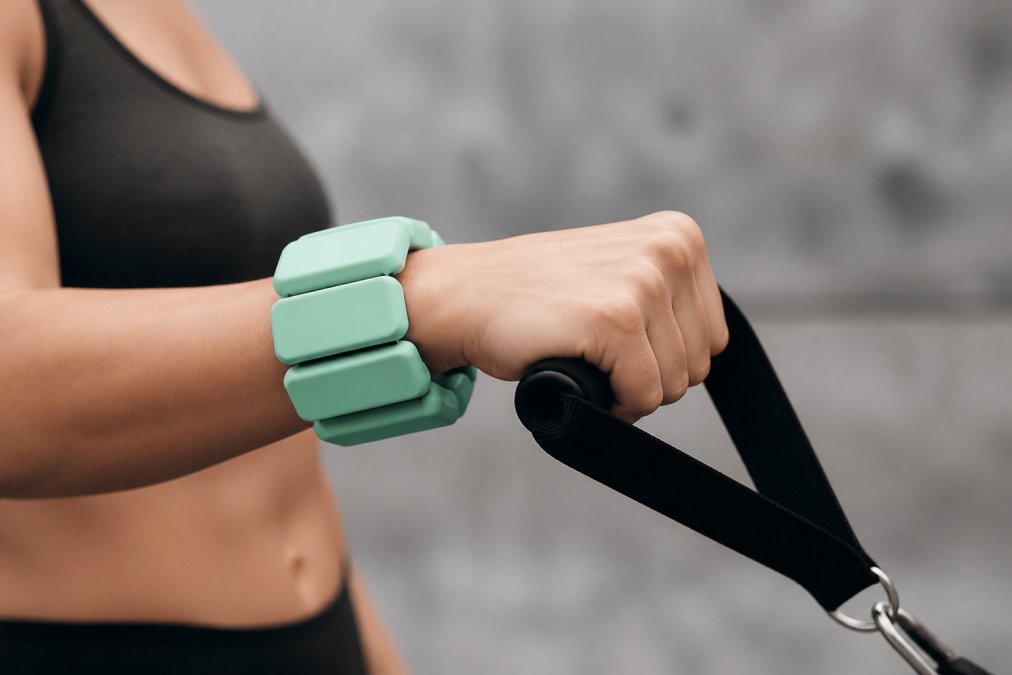
Joint stress increases significantly when you add weight to your wrists, especially during repetitive movements. Your wrist joint wasn't designed to handle constant external load the way your shoulder or hip joint was. Form breakdown is the second major risk factor, as your muscles fatigue, poor form often manifests as wrist flexion or extension rather than neutral alignment, creating repetitive strain on the tendons that cross the wrist joint.
Preventing injury requires three specific strategies:
-
Progressive overload done correctly. Start with 1-2 pound bands and wear them for 2-3 weeks before adding weight. Increase by half-pound increments. Connective tissue adapts slower than muscle, so moving too quickly creates injury risk (peer-reviewed research).
-
Maintain neutral wrist alignment throughout every exercise. Your wrist should stay straight, not bent forward, backward, or to the sides. If you notice your wrist bending to accommodate fatigue, stop the set.
-
Include adequate recovery between sessions. Training with weighted wrist bands 3-4 times per week with at least one rest day between sessions allows tissue repair. Training daily increases injury risk substantially.
How to Use Weighted Wrist Bands for Strength Training
Proper technique with weighted wrist bands differs from traditional lifting because the weight is distributed along your forearm rather than concentrated in your hand. The foundational principle is maintaining neutral wrist alignment, your wrist stays straight and stable throughout every movement, never flexing or extending under load.
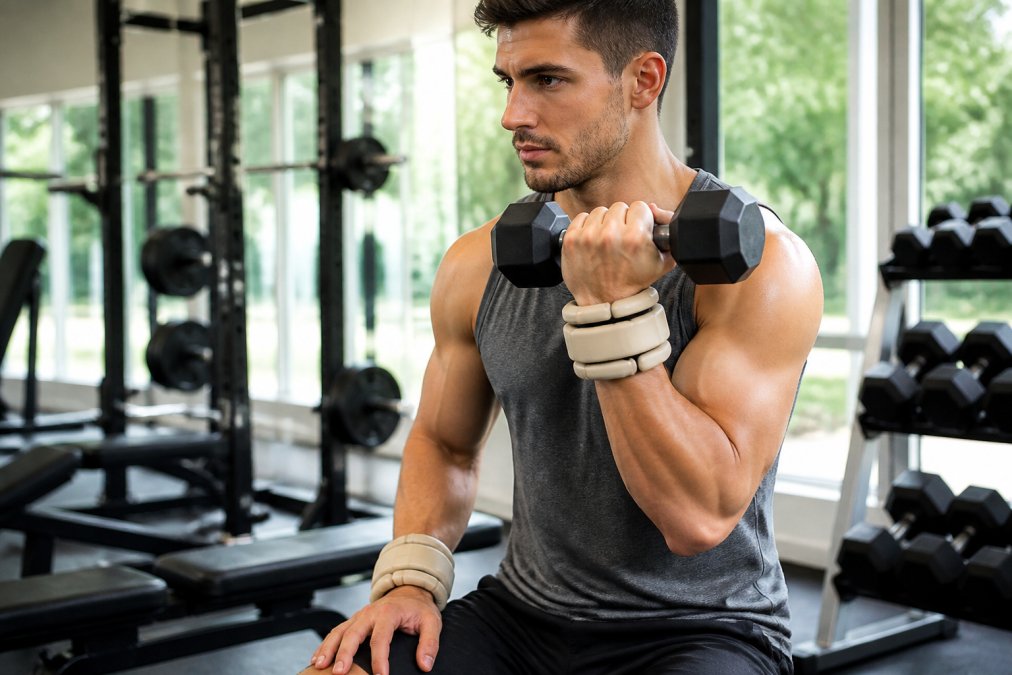
Start every exercise with the bands fastened securely around your wrists, positioned just above the wrist crease. They should sit snugly but not restrict blood flow. Basic exercises that work well with weighted wrist bands include bicep curls, overhead presses, walking or jogging, push-ups, and lateral raises. Keep your wrists neutral and straight throughout each movement.
Progressive Overload Strategy
Progressive overload means systematically increasing the challenge your muscles face over time. Start with a weight that allows you to complete 12-15 repetitions with good form while feeling moderate fatigue in the final 2-3 reps. Perform this weight for 2-3 weeks, focusing on perfect form and consistent execution.
The progression sequence works like this:
- Weeks 1-3: Establish baseline with current weight. Focus on form and consistency.
- Week 4: Increase repetitions by 2-3 reps if possible while maintaining form.
- Weeks 5-6: Once repetitions plateau, increase weight by 0.5 pounds.
- Repeat the cycle with the new weight.
This approach builds muscular endurance and strength simultaneously while minimizing injury risk.
Form Fundamentals for Beginners
Beginners often move too fast, use too much weight, and neglect wrist alignment. Slow, controlled movements produce better results and lower injury risk. Each repetition should take 2-3 seconds on the way up and 2-3 seconds on the way down. Wrist alignment is non-negotiable, before every set, check that your wrists are straight and neutral. Quality matters more than quantity: performing 8 perfect repetitions produces better results than 15 sloppy repetitions where your wrists bend and your joints compensate.
Weighted Wrist Bands vs. Dumbbells and Other Resistance Tools
The choice between weighted wrist bands and dumbbells depends on your training goal and lifestyle. Dumbbells allow higher absolute loads, making them superior for building hypertrophy and maximum strength. Weighted wrist bands excel at portability and adding resistance to dynamic movement without needing equipment.
| Tool | Best For | Load Range | Portability | Joint Safety |
|---|---|---|---|---|
| Weighted wrist bands | Endurance, cardio enhancement, beginners | 1-10 lbs per wrist | Excellent | High |
| Dumbbells | Strength, hypertrophy, power | 5-100+ lbs | Moderate | Moderate |
| Resistance bands | Variable resistance, rehab | Light to moderate | Excellent | Very high |
| Barbells | Maximum strength, heavy lifting | 45-500+ lbs | Poor | Moderate |
Most serious strength athletes use weighted wrist bands as a supplemental tool alongside dumbbells or barbells, not as a replacement. Health and Fitness Company's Adjustable Weighted Fitness Wrist and Ankle Band allows you to adjust load from 1 to 10 pounds, making progression straightforward without buying multiple pairs.

Who Should Use Weighted Wrist Bands?
Beginners benefit significantly from weighted wrist bands because they provide controlled resistance without overwhelming joints. Athletes focused on muscular endurance and functional fitness see excellent results. Runners, cyclists, and cardio enthusiasts can add upper body resistance without equipment, improving overall fitness and caloric expenditure.
People in physical therapy or rehabilitation often use weighted wrist bands because they allow precise load control and low joint stress. Fitness enthusiasts who travel frequently benefit from wrist bands' portability. People with joint concerns, arthritis, previous injuries, or chronic pain can use weighted wrist bands for upper body training with lower impact than traditional weights.
Conversely, weighted wrist bands are NOT ideal for people whose primary goal is building maximum muscle mass. If hypertrophy is your target, dumbbells and barbells provide the heavy loads necessary for significant growth.
The effectiveness of weighted wrist bands comes down to realistic expectations and consistent use. They're not a magic solution, nor are they inferior to dumbbells, they're a different tool suited to specific applications. When you use them correctly with proper form, appropriate progression, and adequate recovery, weighted wrist bands deliver measurable improvements in muscular endurance, functional fitness, and cardiovascular capacity.
Health and Fitness Company's Adjustable Weighted Fitness Wrist and Ankle Band provides the precision and durability needed for serious training. The adjustable design means you can progress from 1 pound to 10 pounds without buying multiple pairs. Start conservatively, progress methodically, and prioritize form over ego, that's the formula for real results with weighted wrist bands.
Frequently Asked Questions
Q: Do weighted wristbands actually work for building muscle?
A: Yes, weighted wrist bands are effective for building muscle when used consistently with proper form. They create resistance that stimulates muscular endurance and hypertrophy in the arms and shoulders. The key is progressive overload, gradually increasing weight or reps over time. Results depend on your training program, nutrition, and consistency rather than the bands alone.
Q: What are the main risks of using wrist weights?
A: The primary risks include tendonitis, shoulder impingement, and repetitive strain injuries when bands are too heavy or form is poor. Beginners often experience wrist pain from incorrect alignment or overuse. Joint stress increases significantly with weighted wrist bands, especially during high-repetition cardio. To prevent injury, start with lighter weights, maintain proper wrist alignment, and limit sessions to 3-4 times per week. Stop immediately if you experience sharp pain rather than muscle fatigue.
Q: How heavy should weighted wrist bands be for a beginner?
A: Beginners should start with 1-2 pound bands per wrist to master form and build connective tissue strength. This weight allows you to complete 12-15 reps with good biomechanics without excessive joint stress. After 2-3 weeks, progress to 2-3 pounds if you can maintain proper form throughout your set. Avoid jumping to heavy weights, this is the most common cause of injury. Our Adjustable Weighted Fitness Wrist and Ankle Band ($91.03) lets you increase resistance gradually as your strength improves.
Q: Can I wear weighted wrist bands during cardio activities?
A: Yes, but with caution. Adding weight increases cardiovascular intensity and caloric expenditure during walking or running, boosting aerobic capacity development. However, the added impact on joints during high-impact cardio raises injury risk. Use lighter weights (1-2 pounds) during cardio and limit sessions to 20-30 minutes. Low-impact activities like swimming or cycling are safer options for weighted wrist band cardio training. Always prioritize proper form and listen to your body for signs of joint stress.
This article was written using GrandRanker