Beginner Strength Training Equipment Guide

Table of Contents
- Why Beginners Need the Right Strength Training Equipment
- Home Gym Equipment Essentials for Starting Out
- How to Use Gym Machines for Beginners
- Strength Training for Beginners Routine
- Free Weights vs. Machine Weights for Beginners
- Recovery Tools and Mobility Equipment
- Budget-Based Equipment Tiers and Durability
- Conclusion
- Frequently Asked Questions
Last Updated: September 4, 2026
Starting a strength training routine is exciting, but the sheer volume of equipment options can make it overwhelming. A solid beginner strength training equipment guide cuts through the noise, helping you choose tools that match your goals, space, and budget. At Health and Fitness Company, we build durable gear for lifters at every stage, and we know that the right setup is the difference between consistency and a closet full of unused gadgets. The core principle is simple: you need equipment that allows for progressive overload, which means gradually increasing the demands on your muscles to stimulate growth. Below, we’ll show you exactly how to build a versatile home gym, master the machines at a commercial facility, and structure your first routines with confidence.
Why Beginners Need the Right Strength Training Equipment
Most beginners quit not because they lack motivation, but because they lack a clear plan and the right tools. The wrong equipment can lead to poor form, frustration, and even injury, while the right setup makes exercise enjoyable and sustainable. Proper equipment supports your joints through a full range of motion, which is critical for building stability and preventing imbalances.
A common mistake is buying the flashiest gear instead of focusing on fundamentals. You do not need a room full of machines to see results. You need a few versatile tools that allow you to perform compound movements like squats, presses, and rows, which recruit multiple muscle groups and deliver the most value for your time. This approach aligns with guidance from the American Council on Exercise on beginner strength training, which emphasizes foundational movement patterns over isolated exercises.
Home Gym Equipment Essentials for Starting Out
Building a home gym does not require a massive budget, but it does require smart choices. Your home gym equipment essentials should focus on versatility, safety, and progressive overload. Before buying anything, measure your available floor space and ceiling height to ensure you can perform exercises safely.
Adjustable Dumbbells and Barbells
Adjustable dumbbells are the single most space-efficient purchase you can make. They replace an entire rack of fixed weights, allowing you to increase resistance as you get stronger. Look for models with non-slip handles and secure weight adjustment mechanisms.
For a budget-friendly option that covers most beginner needs, the Adjustable Dumbbell Barbell Weight Pair from Health and Fitness Company works as both dumbbells and a barbell using a connecting rod. If you want a more versatile system that also functions as kettlebells and push-up stands, the FIXTECH Adjustable Dumbbell Set offers four-in-one functionality. Adjustable sets are a wise investment because they grow with you; a fixed pair of 10 lb dumbbells will become useless within months.


Resistance Bands for Progressive Overload
Resistance bands are often overlooked, but they are essential for progressive overload, especially for accessory work and mobility. They provide variable resistance, meaning the exercise gets harder as the band stretches, which challenges your muscles through the entire movement.
Bands are also perfect for travel and warm-ups. The Rubber Resistance Band Set includes multiple resistance levels, a door anchor, and an ankle strap, giving you a full gym in a small carrying case. A single Strength Resistance Band is ideal for leg and hip exercises, while the Fitness Resistance Band with its detachable cord is great for toning and muscle building. Unlike machines, bands are cheap, quiet, and take up almost no space, making them a cornerstone of any home setup.

How to Use Gym Machines for Beginners
If you prefer a commercial gym, machines can feel intimidating, but they are actually excellent for beginners because they guide your movement path. This reduces the risk of using improper form compared to free weights, allowing you to learn muscle activation patterns safely before progressing to more complex lifts.
Proper Form and Safety Principles
Before touching any machine, read the instructional placard and adjust the seat and pads to fit your body. The movement should feel controlled, not jerky, and you should never lock out your joints at the top of a rep. A common mistake is using momentum to swing the weight, which reduces muscle tension and increases injury risk.
Always start with a weight you can lift for 15 reps with perfect technique. If you cannot maintain control, the weight is too heavy. As a general rule, exhale during the pushing or pulling phase and inhale during the return to the starting position.
One overlooked step is checking the pin placement. Most machines use a weight stack with a numbered pin that you insert to select resistance. Beginners often insert the pin incorrectly or fail to ensure it is fully seated, which can cause the weight to shift unexpectedly. Before your first rep, pull the pin out slightly and reinsert it firmly to confirm it is locked in place.
Common Machine Types and Their Purpose
Understanding what each machine does helps you build a balanced routine. Here are the most common machines you will encounter and how to use them safely:
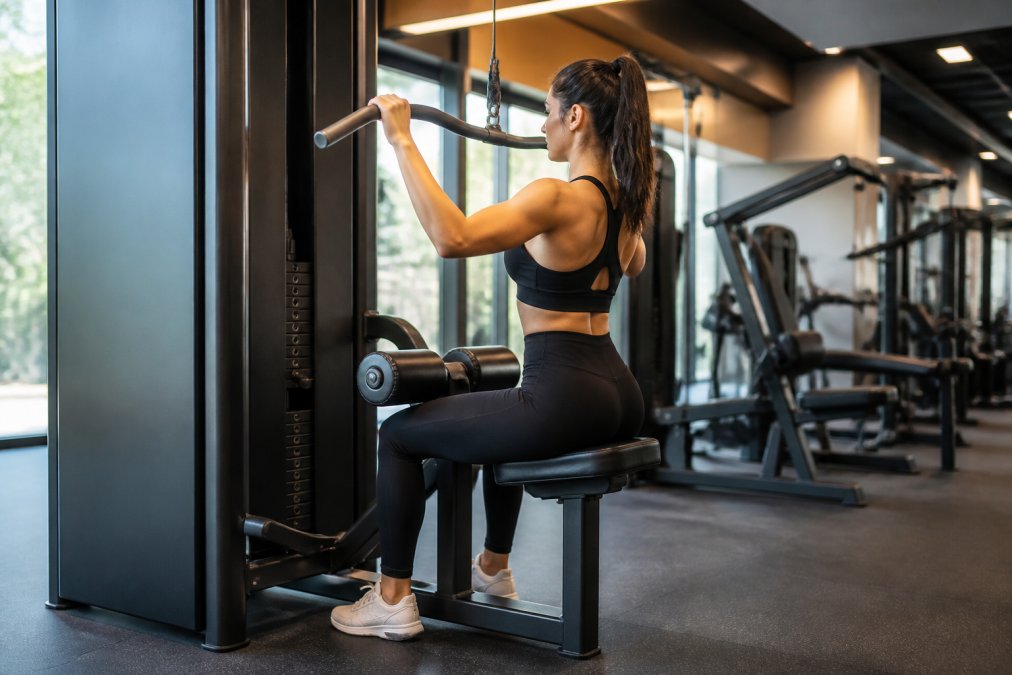
Lat Pulldown targets the back muscles. Sit upright with your chest proud and feet flat on the floor. Grip the bar slightly wider than shoulder-width. Pull the bar down toward your upper chest (not your neck) by driving your elbows down and slightly back. Avoid leaning backward excessively; this is a common form break that shifts tension away from the lats. Return the bar to the starting position with control. A common mistake is pulling the bar behind your neck, which can strain your shoulder joints.
Chest Press focuses on the pectorals and triceps. Adjust the seat so the handles align with the middle of your chest. Plant your back firmly against the pad and keep your feet on the floor or footrest. Press the handles forward in a straight line, stopping just short of locking your elbows. Avoid flaring your elbows out to the sides; they should stay at roughly a 45-degree angle from your body. Return the handles to your chest with control. If you feel shoulder pain rather than chest tension, the seat height is likely too high.
Leg Press works the quadriceps and glutes without loading your spine. Sit with your back and head resting against the pad. Place your feet on the platform about shoulder-width apart, with your toes pointing slightly outward. Lower the weight by bending your knees until they reach roughly a 90-degree angle, do not go deeper, as this can place excessive stress on your knees and lower back. Press through your heels to extend your legs, stopping just short of locking your knees at the top. A critical safety rule: never allow your knees to cave inward during the movement, and never lock your knees at full extension.
Seated Cable Row is excellent for the mid-back and improving posture. Sit upright with your chest against the pad (if available) and grab the handles with a neutral grip (palms facing each other). Pull the handles toward your torso by driving your elbows back and squeezing your shoulder blades together. Your torso should remain upright; avoid rounding your lower back or leaning backward to generate momentum. Return the handles to the starting position with control. This machine is particularly valuable for beginners because it teaches proper scapular retraction, which is essential for healthy shoulders.
Smith Machine is a barbell housed in a fixed vertical or slightly angled track. While it reduces the stability demands of free-weight exercises, it is excellent for learning squat and bench press patterns safely. Always ensure the safety catches are set at an appropriate height before loading weight. The fixed path can feel unnatural at first, but it allows you to focus on range of motion and muscle activation without worrying about balance.
These machines isolate specific muscle groups, which is why they are often called isolation exercises. While compound movements like squats are more efficient for overall strength, machines are fantastic for targeting weak points, building a mind-muscle connection early on, and allowing you to train safely without a spotter.
Strength Training for Beginners Routine
Your first strength training for beginners routine should be simple and repeatable. Aim for a full-body workout three times per week, with at least one rest day between sessions to allow for muscle recovery and growth.
Full-Body Workout Structure
A balanced full-body workout includes one exercise for each major movement pattern: a hip hinge, a squat, a push, and a pull. A sample session might look like this:
- Goblet squat (dumbbell or bodyweight)
- Push-ups (knee or full)
- Seated cable row or resistance band row
- Glute bridge
- Plank for core stability
Perform each exercise for 3 sets of 8-12 reps. This rep range is ideal for hypertrophy, which is the process of building muscle size. Rest for 60-90 seconds between sets.
Reps, Sets, and Training Frequency
Training frequency refers to how often you train a muscle group per week. For beginners, three full-body sessions per week is more effective than doing one body part per day. This frequency allows you to practice the movements often enough to improve skill while providing adequate recovery.
Progressive overload is the key to continued progress. Each week, try to add a small amount of weight or perform one additional rep on your last set. Tracking your lifts in a notebook or app is non-negotiable if you want to get stronger.
Free Weights vs. Machine Weights for Beginners
The debate between free weights and machines is settled by looking at your goals. Free weights (dumbbells and barbells) require more stability and recruit more stabilizer muscles. Machines are safer for absolute beginners and allow you to push closer to failure without a spotter.
For most beginners, a hybrid approach is best. Use machines to learn the movement patterns and build a baseline of strength, then transition to free weights to challenge your stability and increase functional strength. This strategy is supported by research highlighted in a review of resistance training variables from the National Strength and Conditioning Association, which notes that both modalities can effectively increase strength in novices.
The real advantage of free weights is their versatility and the fact that they translate better to everyday activities. If you can only choose one, start with adjustable dumbbells, as they allow for an endless variety of exercises and are safer for solo training than a heavy barbell.
Recovery Tools and Mobility Equipment
Strength training breaks down muscle tissue; recovery is where you rebuild stronger. Neglecting recovery leads to burnout and injury. Essential recovery tools include a foam roller for self-myofascial release and a massage ball for targeting specific trigger points.
Incorporating mobility exercises and a proper cool-down routine into your sessions improves your range of motion and reduces post-workout soreness. A good warm-up routine should include dynamic stretches like leg swings and arm circles, while your cool-down should feature static holds. Using a foam roller for 5-10 minutes after your workout can significantly improve blood flow and speed up recovery.
Budget-Based Equipment Tiers and Durability
You do not need to spend a fortune to start, but you should avoid the cheapest options, which often break or fail to provide enough resistance. Here is a practical breakdown of how to allocate your budget:
| Budget Tier | Recommended Equipment | Key Consideration |
|---|---|---|
| Entry Level | Resistance band set + yoga mat | Focus on bodyweight exercises and band work |
| Mid Range | Adjustable dumbbells (up to 50 lbs) + bench | Covers most compound lifts for 1-2 years |
| Premium | Full adjustable barbell set + power rack | Allows for heavy squats and deadlifts safely |
Equipment maintenance is a topic most guides miss. Wipe down handles and benches after use, check resistance bands for micro-tears before each session, and occasionally tighten the collars on adjustable dumbbells. Consumer guidance on maintaining home fitness equipment suggests that proper storage away from direct sunlight extends the life of rubber and plastic components significantly. A well-maintained set of adjustable dumbbells will last for decades, making them a better long-term investment than a cheap fixed-weight set that you will outgrow.
Conclusion
Starting your strength journey is about making informed choices, not perfect ones. Focus on equipment that allows for progressive overload, supports safe movement, and fits within your physical space.
Frequently Asked Questions
What is the best beginner strength training equipment to start with?
Adjustable dumbbells, resistance bands, and a sturdy bench form the foundation of beginner strength training equipment. These tools allow you to perform compound movements like chest presses, squats, and rows while maintaining proper form. Dumbbells offer progressive overload by adjusting weight, while resistance bands provide variable resistance that challenges your muscles throughout the range of motion. Starting with these essentials keeps costs manageable while delivering full-body training results.
How often should a beginner strength train per week?
Beginners should aim for 3 days per week of strength training, with at least one rest day between sessions. This frequency allows your muscles adequate recovery time while building consistency. Each session should target different muscle groups or use varied compound movements to avoid overuse injuries. Three days per week is sustainable long-term and prevents burnout while delivering measurable progress in strength and muscle development.
Do I need expensive equipment to start strength training?
No. Effective strength training begins with basic tools: adjustable dumbbells, resistance bands, and bodyweight exercises. Resistance bands cost under $40 and provide excellent resistance for isolation exercises and mobility work. Adjustable dumbbells eliminate the need to buy multiple sets at different weights, saving money and space. Bodyweight exercises like push-ups, squats, and planks require zero investment. Progressive overload comes from increasing reps, sets, or resistance, not equipment price.
What is the difference between free weights and machine weights for beginners?
Free weights (dumbbells, barbells) require you to stabilize the load, engaging more muscle groups and improving functional strength. Machines guide movement along a fixed path, making them safer for beginners learning proper form and reducing injury risk. Beginners benefit most from combining both: machines for controlled, isolated movements and free weights for compound movements that build stability and real-world strength. Start with machines to build confidence, then progress to free weights.
How do I know if strength training equipment will last long enough to justify the cost?
Quality strength training equipment features durable construction, non-slip handles, and corrosion-resistant materials. Look for adjustable dumbbells with embossed metal plates and secure locking mechanisms that won't loosen over time. Resistance bands made from high-quality rubber maintain elasticity and grip after months of use, unlike cheap alternatives that snap or lose tension. Investing in equipment from reputable brands ensures longevity, making the upfront cost worthwhile over years of consistent training.
Can beginners use weighted resistance bands and ankle weights without compromising form?
Yes, when introduced gradually. Start with bodyweight movements to establish proper form and stability, then add light resistance bands or ankle weights once you've mastered the movement pattern. Adding weight too early can break your form and increase injury risk. Use resistance bands for isolation exercises and mobility work, which are forgiving and allow you to maintain control. Progress slowly, focusing on controlled movement and proper range of motion rather than heavy weight.
What recovery tools should beginners include in their strength training routine?
Foam rollers and mobility bands are essential recovery tools for beginners. Foam rolling reduces muscle soreness and improves blood flow after workouts, while mobility exercises enhance range of motion and prevent injury. Spend 5-10 minutes post-workout on cool-down stretches and light foam rolling. These tools cost little but significantly improve recovery between training sessions, reduce injury risk, and enhance long-term progress. Recovery is as important as the workout itself for sustainable strength development.
At Health and Fitness Company, we design adjustable weighted gear and resistance tools with durability and precision in mind, so your investment supports you from your first rep to your heaviest set. Our adjustable dumbbell sets and resistance bands are built to withstand consistent use and help you reach your full potential. Get started with Health and Fitness Company and build the home gym that grows with you.
This article was written using GrandRanker