Best Alloy Handlebars for Mountain Bikes in 2026

Table of Contents
- Why Alloy Handlebars for Mountain Bikes Still Dominate the Trail
- Quick Comparison: Top Alloy MTB Handlebars at a Glance
- Alloy vs Carbon Handlebars for MTB: Which One Is Right for You?
- MTB Handlebar Rise and Sweep Explained
- How to Choose Mountain Bike Handlebar Width for Your Riding Style
-
The Best Alloy Handlebars for Mountain Bikes: Our Top Picks
- 1. Race Face Atlas: Best for Gravity and Enduro Riders
- 2. PNW Range Gen 3: Best for Long-Ride Comfort
- 3. Renthal Fatbar Lite V2: Best Lightweight Alloy Option
- 4. Deity Blacklabel 800: Best for Downhill and Aggressive Trail
- 5. OneUp Components Alloy Bar: Best for Vibration Damping
- 6. Spank Spoon 35: Best Versatile All-Mountain Pick
- 7. Chromag Fubars OSX 35: Best for Stiffness and Steering Precision
- 8. Truvativ Descendant: Best for Responsive Downhill Handling
- Which Alloy MTB Handlebar Should You Pick?
- Conclusion
Last Updated: August 7, 2026
Alloy handlebars account for the vast majority of mountain bikes sold in the United States for good reason. The best alloy handlebars for mountain bikes offer impact resistance, repairability, and durability that carbon cannot match at the same price point. Below, we'll cover how to match handlebar geometry to your riding style, why the "alloy is dead" narrative is wrong, and which eight bars stand out. We'll also address two things most guides skip: long-term fatigue testing and whether modern 35mm cockpit systems change the equation.
Why Alloy Handlebars for Mountain Bikes Still Dominate the Trail
Alloy handlebars are the default choice because they fail predictably. Carbon bars can delaminate or crack without visible warning. An alloy bar bends before it breaks, giving you a clear signal that replacement is needed.
The two most common alloys are 6061 aluminum (more ductile, used in budget options) and 7075 aluminum (higher tensile strength, used in gravity-focused bars). A third option, 2014-T73 aluminum (used in the PNW Range Gen 3), is valued for vibration damping. Manufacturing processes matter as much as alloy grade. Shot-peening compresses the outer metal layer and significantly improves fatigue resistance. Internal butting allows engineers to place material where stress concentrates.
A well-engineered alloy bar can be lighter, more durable in a crash, and more serviceable than an equivalent carbon option. The best alloy handlebars are not a compromise, they're a deliberate choice.
Quick Comparison: Top Alloy MTB Handlebars at a Glance
| Handlebar | Alloy Grade | Width | Rise Options | Clamp | Best For |
|---|---|---|---|---|---|
| Race Face Atlas | 7000-series | 800mm | 20/40/55mm | 35mm | Gravity and enduro |
| PNW Range Gen 3 | 2014-T73 | 800mm | 30mm | 31.8 or 35mm | Long-ride comfort |
| Renthal Fatbar Lite V2 | 7050 T6 | 760mm | 10/20/30/40mm | 31.8mm | Lightweight trail/XC |
| Deity Blacklabel 800 | 7075 T73 | 800mm | 15/25/38/50mm | 31.8mm | DH and aggressive trail |
| OneUp Alloy Bar | 7075-T76 | 800mm | 20/35mm | 35mm | Vibration damping |
| Spank Spoon 35 | MGR 6-Series | 800mm | 25/40/60mm | 35mm | Versatile all-mountain |
| Chromag Fubars OSX 35 | 7050 series | 800mm | 25/35mm | 35mm | Stiffness and precision |
| Truvativ Descendant | 7050 | 760/800mm | 20/25mm | 31.8 or 35mm | Responsive DH handling |
Alloy vs Carbon Handlebars for MTB: Which One Is Right for You?
The alloy vs carbon debate is more nuanced than most forums suggest. Carbon wins on weight. Alloy wins almost everywhere else.
A carbon handlebar at the same weight as a high-end alloy bar costs roughly two to three times as much. Alloy bars with internal butting and oval cross-sections now achieve compliance numbers previously only possible with carbon. The gap has closed.
The 'Compliance' Myth in Alloy: What the Data Actually Shows
Conventional wisdom says alloy bars are stiff and harsh, while carbon bars absorb vibration. This is increasingly outdated.
Compliance is a product of cross-sectional geometry, wall thickness distribution, and alloy grade. A round-section 7075 bar feels stiffer than a round-section 6061 bar. But change the cross-section to an oval shape, as OneUp Components has done, and vertical compliance increases substantially without sacrificing lateral steering stiffness. Race Face's GL Tune technology achieves similar results through butting profile optimization.
If you're switching to alloy from carbon and expecting a harsh ride, you may be surprised. The right alloy bar delivers trail feedback and comfort comparable to mid-range carbon.
Long-Term Fatigue Testing: How Alloy Holds Up Over Time
Aluminum alloys used in handlebars are tested to EN 4210 or ISO 4210 standards, which simulate thousands of load cycles at defined forces. According to ASTM International standards for bicycle components, fatigue life is heavily influenced by surface finish and residual stress state. Shot-peening and anodizing directly address these factors by inducing compressive surface stresses that resist crack initiation.
A quality alloy bar from a reputable manufacturer, inspected regularly and replaced after significant impact, will outlast the rest of your drivetrain. The failure mode is visible deformation, not invisible delamination.
MTB Handlebar Rise and Sweep Explained
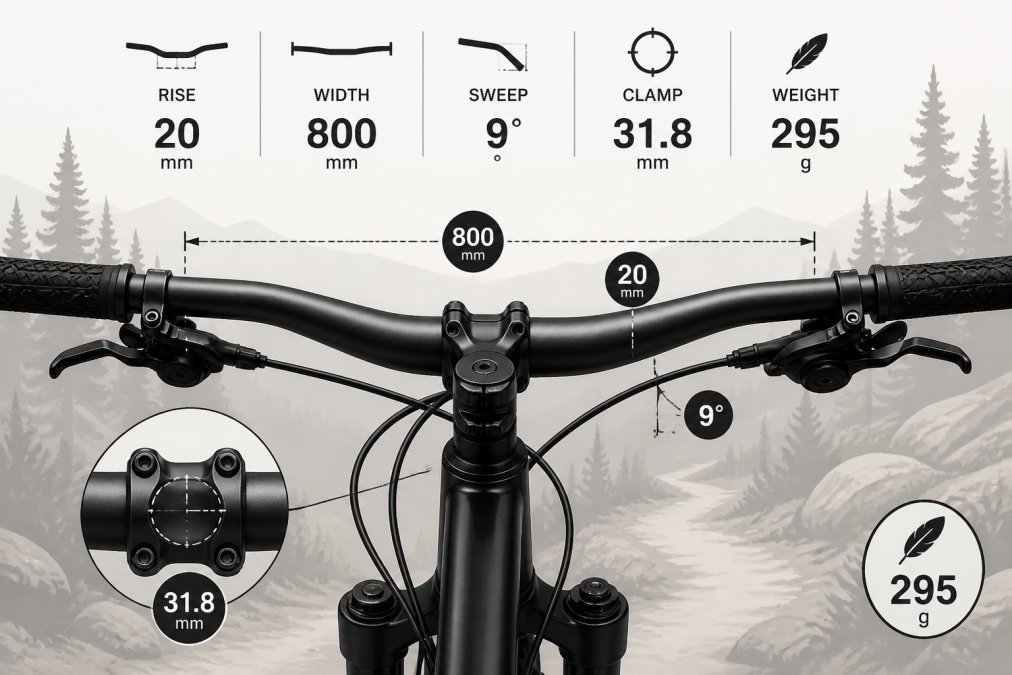
Handlebar rise is the vertical distance from the clamp center to the grip ends. Backsweep is the rearward angle of the bar, and upsweep is the upward angle toward the grip ends. Together, these define your cockpit geometry and directly affect rider posture, arm pump, and control on technical terrain.
Higher rise bars (40mm and above) put your hands higher, opening your chest and shifting weight rearward, suited to aggressive trail and enduro riding. Lower rise bars (10-20mm) keep you more forward and aerodynamic, suited to cross-country racing. Most trail riders land in the 20-40mm range.
Backsweep, Upsweep, and Bar Roll: Setting Up Your Cockpit Geometry
Backsweep is the most misunderstood dimension. Most alloy bars run between 7 and 10 degrees. More backsweep rotates your wrists into a more neutral position, reducing ulnar deviation and lowering wrist and elbow fatigue risk. Riders suffering from arm pump on longer descents often find that moving from 7 to 9 degrees of backsweep, combined with a slight bar roll adjustment, resolves the issue.
Bar roll is the rotation of the handlebar around the clamp axis, adjusted during installation by loosening the stem faceplate and rotating the bar before retightening. Most riders find their ideal position through experimentation across a few rides.
How to Choose Mountain Bike Handlebar Width for Your Riding Style
Handlebar width is one of the most consequential decisions in cockpit setup, and most riders default to whatever came on their bike.

A wider bar (780-800mm) increases leverage, slows steering, and improves stability at speed on open, technical terrain. A narrower bar (720-760mm) quickens steering, suits tighter singletrack, and reduces the chance of catching obstacles. Cross-country racers prefer 720-760mm. Enduro and downhill riders typically run 780-800mm.
Starting point: measure your shoulder width in centimeters, multiply by 2.54 to get inches, and convert to millimeters. Most riders end up within 20mm of this figure. Trim marks on quality bars let you cut down from factory width in 5mm or 10mm increments. Note that trimming an alloy bar increases its stiffness.
Clamping Diameter: 31.8mm vs 35mm and Cockpit Integration
The clamping diameter determines stem compatibility and is critical for modern cockpit integration.
31.8mm is the legacy standard with a wider range of compatible stems. 35mm is the current performance standard for trail, enduro, and downhill. The larger diameter increases bar-stem interface stiffness, improving steering precision and reducing flex under hard braking and cornering.
For new builds or upgrades to enduro or DH bikes, 35mm is the correct choice. For cross-country or older trail bikes, check your stem's bore size before ordering.
The Best Alloy Handlebars for Mountain Bikes: Our Top Picks
The eight bars below represent the strongest options across every riding discipline and budget.
1. Race Face Atlas: Best for Gravity and Enduro Riders
The Race Face Atlas is the bar to beat for all-mountain and enduro riding. Its 7000-series aluminum construction and GL Tune butting profile reduce hand fatigue on long, rough descents without sacrificing lateral stiffness for precise steering. Three rise options (20mm, 40mm, 55mm) cover the full range of enduro and gravity setups. The 800mm width trims to 760mm. The 35mm clamp diameter is standard for this category.
Best for: All-mountain, enduro, gravity, and eMTB riders.
2. PNW Range Gen 3: Best for Long-Ride Comfort
The PNW Range Gen 3 uses 2014-T73 aluminum, specifically selected for vibration damping properties. Combined with 10 degrees of backsweep and 5 degrees of upsweep, this bar is engineered for comfort on extended rides. Available in both 31.8mm and 35mm clamp diameters, it suits a wider range of builds.
Best for: Trail, all-mountain, and enduro riders who prioritize wrist and back comfort on rides over two hours.
3. Renthal Fatbar Lite V2: Best Lightweight Alloy Option
The Renthal Fatbar Lite V2 is one of the lightest alloy options available. Its 7050 T6 aluminum construction, shot-peened and anodized finish, and four rise options (10mm, 20mm, 30mm, 40mm) make it versatile for trail, XC, and enduro racers. The 760mm factory width suits tighter trail environments and XC racing positions.
Best for: Trail, XC, and enduro racers prioritizing lightweight alloy with multiple rise options.
4. Deity Blacklabel 800: Best for Downhill and Aggressive Trail
The Deity Blacklabel 800 uses Gradient Butting Technology on custom 7075 T73 aluminum. Four rise options (15mm, 25mm, 38mm, 50mm) cover everything from aggressive trail to full DH geometry. The 9-degree backsweep and 5-degree upsweep suit the forward, attack-position riding style of downhill and enduro racing. The Deity Lifetime Crash Replacement Policy provides a replacement path after significant crashes.
Best for: DH, enduro, and aggressive trail riders wanting World Cup-proven construction.
5. OneUp Components Alloy Bar: Best for Vibration Damping
The OneUp Alloy Bar's patented oval cross-section increases vertical compliance while maintaining lateral stiffness. This applies carbon bar principles to 7075-T76 aluminum with a downhill rating. In practice, it genuinely reduces hand fatigue in a way most round-section bars cannot match.
Best for: Trail and enduro riders seeking carbon-like vibration damping in a durable, downhill-rated alloy bar.
6. Spank Spoon 35: Best Versatile All-Mountain Pick
The Spank Spoon 35 covers more riding disciplines than any other bar. Three rise options (25mm, 40mm, 60mm), width range from 800mm to 740mm, and compatibility with freeride and DH use make it the most versatile alloy bar available. The MGR 6-Series alloy (zirconium-doped 7-series) offers balance between strength and compliance.
Best for: All-mountain, trail, freeride, DH, and eMTB riders wanting one bar across disciplines.
7. Chromag Fubars OSX 35: Best for Stiffness and Steering Precision
The Chromag Fubars OSX 35 uses 7050 series aluminum with advanced HTX heat treatment for consistent material properties. The 35mm clamp diameter and 800mm width create a stiff, wide cockpit platform rewarding precise, aggressive riding. The 8-degree backsweep and 5-degree upsweep suit riders preferring a more neutral wrist position.
Best for: Aggressive trail, enduro, and downhill riders prioritizing steering precision and cockpit stiffness.
8. Truvativ Descendant: Best for Responsive Downhill Handling
The Truvativ Descendant uses 7050 aluminum optimized for stiffness and responsive steering. Available in 760mm or 800mm widths and 20mm or 25mm rise options, it suits riders wanting a lower, more aggressive cockpit position. The 35mm version offers 9-degree backsweep, providing a more comfortable wrist angle than the 31.8mm version.
Best for: Downhill and aggressive enduro riders prioritizing responsive, precise steering.
Which Alloy MTB Handlebar Should You Pick?
The right bar depends on your riding discipline, existing cockpit setup, and sensitivity to vibration.
| Riding Style | Top Pick | Why |
|---|---|---|
| Gravity / Enduro | Race Face Atlas | Wide rise range, GL Tune compliance, 35mm clamp |
| Long-ride comfort | PNW Range Gen 3 | 2014-T73 alloy, 10-degree backsweep, dual clamp options |
| Lightweight trail/XC | Renthal Fatbar Lite V2 | 7050 T6, shot-peened, four rise options |
| DH / Aggressive trail | Deity Blacklabel 800 | 7075 T73, Gradient Butting, crash replacement policy |
| Vibration damping | OneUp Alloy Bar | Patented oval section, downhill-rated 7075 |
| All-mountain versatility | Spank Spoon 35 | Widest rise range, zirconium-doped alloy |
| Steering precision | Chromag Fubars OSX 35 | HTX heat treatment, stiff 35mm platform |
| Responsive DH | Truvativ Descendant | 7050 alloy, geometry varies by clamp diameter |
If you're upgrading from a stock bar and aren't sure where to start, the Race Face Atlas or PNW Range Gen 3 cover the most ground for most riders. Both offer 35mm clamp diameter, meaningful geometry options, and alloys prioritizing real-world performance.
For riders told they need carbon for comfort, the OneUp Alloy Bar is the most direct counter-argument. Its oval cross-section design is a genuine engineering solution to vibration damping.
According to Bicycle Product Suppliers Association industry data, alloy handlebars continue to represent the majority of replacement handlebar sales in the US market, reflecting both their price accessibility and proven durability.
Before you order:
- Confirm your stem clamp diameter (31.8mm or 35mm)
- Measure your current bar width and note whether you want to go wider or narrower
- Identify your current rise and whether your riding position needs adjustment
- Check cable and hose lengths if switching to a significantly different width
- Decide on backsweep priority: comfort (9-10 degrees) vs. precision (7-8 degrees)
The best alloy handlebars for mountain bikes are not a second-best option. They're the right tool for most riders, most of the time.
Frequently Asked Questions
Are alloy handlebars better than carbon for mountain bikes?
For most riders, alloy handlebars for mountain bikes offer a better balance of durability and cost. Alloy bars made from 7075 or 7050 aluminum withstand impacts that can crack carbon fiber, making them the safer choice for aggressive trail riding. Carbon bars save weight and can dampen high-frequency buzz, but alloy bars with oval or butted profiles now close much of that vibration gap. Unless you are racing cross-country and every gram counts, alloy is the more practical pick.
What is the best handlebar width for trail riding?
Most trail riders find 760mm to 800mm works well for mountain bike handlebar width. Wider bars improve leverage and control on technical terrain, while narrower bars suit tighter, faster cross-country tracks. A good starting point is shoulder width: stand upright, measure shoulder to shoulder, and match that measurement. From there, trim in 5mm increments using the bar's trim marks until steering feels natural without arm pump or shoulder strain.
Do alloy handlebars absorb vibration as well as carbon?
Standard round alloy bars transmit more trail feedback than carbon, but modern alloy designs have narrowed the gap significantly. The OneUp Components bar uses a patented oval cross-section that increases vertical compliance, and the Race Face Atlas uses GL Tune butting to soften buzz. Shot-peened and internally butted alloy bars also improve fatigue resistance and compliance. For most trail and enduro riders, the difference is noticeable only on very long, rough rides.
What is the standard clamp diameter for MTB handlebars?
The two most common clamp diameters are 31.8mm and 35mm. Most trail and all-mountain bikes built before 2018 use 31.8mm stems, so those bars offer the widest compatibility. The 35mm standard, introduced for stiffer cockpit geometry on enduro and downhill bikes, requires a matching 35mm stem. Before buying, check your stem's clamp bore. Brands like PNW Components offer both diameters, so you can upgrade without replacing your stem.
What rise should I choose for my mountain bike handlebar?
MTB handlebar rise controls how upright you sit and how much weight loads your front wheel. Low rise (10mm to 20mm) suits cross-country and XC riders who want an aggressive, weight-forward position for climbing efficiency. Mid rise (25mm to 40mm) works for trail and all-mountain riding, balancing comfort and control. High rise (50mm or more) is common in downhill and enduro setups where a more upright posture reduces arm pump on long descents. Pair rise with bar roll adjustments to fine-tune wrist angle.
Upgrading your cockpit is one of the highest-impact changes you can make to your mountain bike's handling and long-ride comfort. Health and Fitness Company offers precision-engineered alloy handlebars built for performance, designed to deliver the durability and control that serious trail riders demand. Visit Health and Fitness Company to find the right bar for your setup and get the most out of every ride.
This article was written using GrandRanker