How to Increase Intensity During Pilates

Table of Contents
- Understanding Pilates Intensity and Progressive Overload
- Adjusting Spring Resistance on the Reformer
- Controlling Tempo and Movement Speed for Greater Muscle Activation
- Incorporating Props Into Pilates Workouts
- How Long Should a High Intensity Pilates Session Be
- Combining Pilates With Traditional Strength Training
- Common Mistakes to Avoid When Increasing Intensity
- Conclusion
Last Updated: August 12, 2026
Understanding Pilates Intensity and Progressive Overload
Progressive overload means gradually increasing demands on your muscles over time. Without it, your body adapts and stops improving. Pilates intensity isn't just about adding weight, it's about manipulating spring resistance, tempo, range of motion, time under tension, and exercise selection. Pilates can deliver serious muscle activation and hypertrophy when you apply progressive overload systematically.
The key variables you control are spring resistance (on reformers), tempo, range of motion, exercise modifications, prop integration, and workout duration. Each independently increases demand on stabilizer muscles and primary movers.
Adjusting Spring Resistance on the Reformer
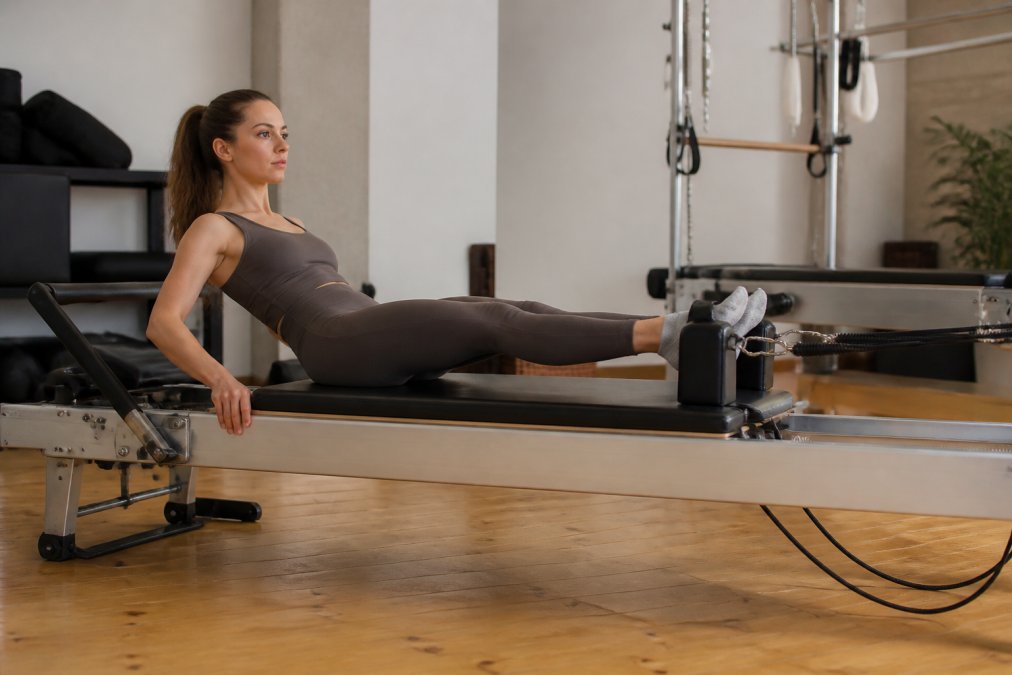
The reformer's spring resistance system is the primary tool for scaling difficulty. Each spring adds resistance throughout the movement. Beginners typically start with 1-2 springs for foundational exercises. As you build strength and control, you increase the number of springs engaged.
Spring tension creates biomechanical disadvantage that's advantageous for muscle development. The further the carriage travels from the anchor point, the greater the lever length and the more force required. This is why footbar exercises feel harder than exercises performed closer to the springs.
A practical progression for beginners: start with 1 spring for basic footbar work. After two weeks of consistent practice, add a second spring. Once that feels controlled, move to exercises with greater lever length while maintaining the same spring count. Advanced practitioners sometimes use all available springs plus additional hand springs or resistance bands for compound movements.
Controlling Tempo and Movement Speed for Greater Muscle Activation
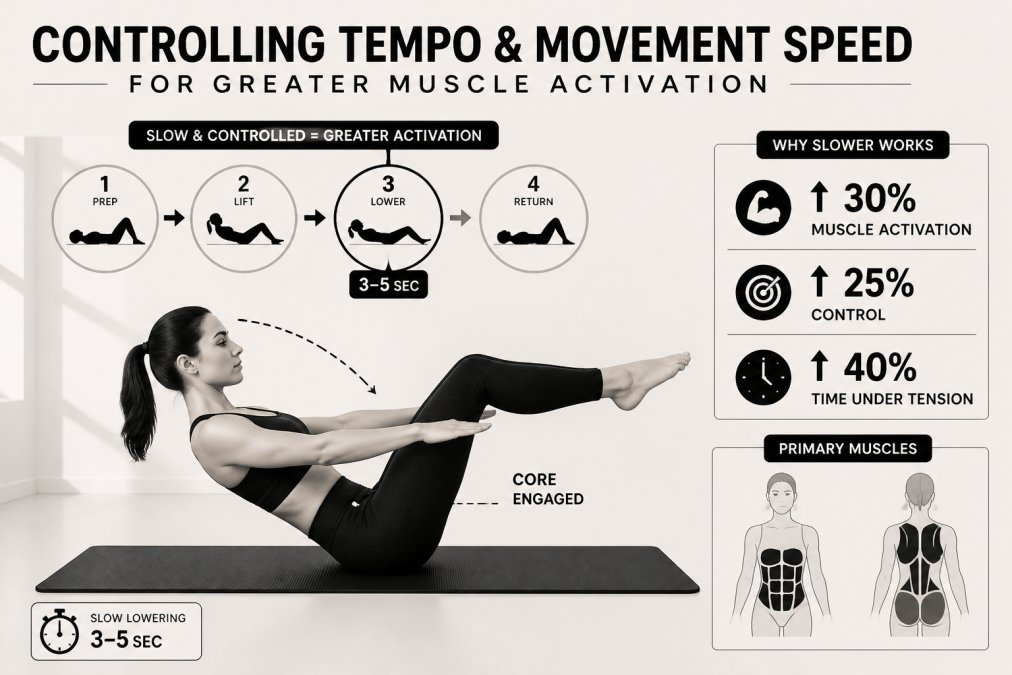
Tempo is the speed at which you perform each phase of a movement: the concentric phase (shortening), the eccentric phase (lengthening), and any pause at the top or bottom. Manipulating tempo is one of the most powerful tools for increasing intensity without adding external resistance.
A standard Pilates movement might follow a 2-2-2 tempo: two counts up, two counts down, two counts pause. To increase intensity, shift to 3-3-3 or even 4-4-2. Slower tempos increase time under tension, which drives muscle fatigue and adaptation. The eccentric phase (lowering) is particularly important for muscle growth. When you slow down the eccentric contraction, you force your muscles to resist a load longer, creating greater mechanical tension and metabolic stress.
A practical tempo protocol for building muscle: perform the concentric phase in 2-3 seconds, pause briefly at the top (1 second), perform the eccentric phase in 3-4 seconds, and pause at the bottom (1 second). This creates a total repetition time of 8-10 seconds. Perform 8-12 repetitions per set. Slow, controlled movement also improves kinesthetic awareness and prevents compensation patterns.
Incorporating Props Into Pilates Workouts
Props transform Pilates into a comprehensive strength training system. The most accessible props are resistance bands, Magic Circles, and weighted accessories. Each adds challenge in different ways, allowing you to scale intensity based on your current strength level.
Resistance bands create variable resistance, tension increases as you stretch the band. This creates greater demand at end range of motion. Bands are portable, affordable, and versatile. Health and Fitness Company's Portable Pilates Bar and Resistance Band ($51.65) combines two tools in one, ideal for home practitioners wanting comprehensive intensity options.

The Magic Circle, also called a Pilates ring, creates resistance through compression. Place the circle between your knees during lying leg exercises and squeeze it throughout the movement. This dramatically increases inner thigh and core activation. Resistance bands work synergistically with Pilates movements, creating resistance at various angles and preventing adaptation.
Magic Circle and Band Resistance
Resistance bands can be anchored in multiple directions, creating resistance at various angles. For example, a standard Pilates leg lift performed against gravity alone becomes significantly more challenging with a band around your thigh.
Weighted Accessories for Added Challenge
Weighted accessories include ankle weights, wrist weights, and weighted vests. These are most effective for practitioners who've already built foundational strength and control. Start with 1-2 pounds per ankle for leg-focused work. Ensure movements remain controlled and joints stay aligned throughout.
Health and Fitness Company offers several options: the Fitness Resistance Band ($37.93) provides variable resistance for full-body Pilates work. The Yoga Elastic Band ($19.15) is ideal for beginners. The Fitness Resistance Elastic Band ($198.95) offers professional-grade resistance for serious practitioners.
How Long Should a High Intensity Pilates Session Be
Duration matters when training for intensity. High-intensity Pilates sessions should be shorter than moderate-intensity sessions because muscles fatigue faster under greater demand. Most practitioners benefit from 30-45 minute sessions. This allows sufficient warm-up, several exercises at high intensity, and proper recovery.
For muscle hypertrophy, 40-45 minutes is ideal. This timeframe allows 4-6 exercises at high intensity with proper form and adequate recovery between sets. For metabolic conditioning, sessions can extend to 50-60 minutes with higher repetition counts (15-20 reps) and minimal rest.
A practical structure for a 45-minute high-intensity session: 5-minute warm-up, 35 minutes of resistance training (4-5 exercises with 3-4 sets each), 5 minutes of cool-down and stretching. Recovery between sessions is equally important. Most practitioners benefit from 48 hours between high-intensity sessions for the same muscle groups.
Combining Pilates With Traditional Strength Training
Pilates and traditional strength training complement each other. Pilates emphasizes core stabilization, eccentric control, and postural alignment, qualities that reduce injury risk and improve performance.
A practical combination approach: perform traditional strength training 3 days per week and add Pilates 2 days per week on separate days. This allows adequate recovery while building complementary qualities. Alternatively, use Pilates as supplemental work after your main strength training, performing 15-20 minutes of high-intensity Pilates.
Avoid excessive volume. If you're already performing high-intensity strength training, adding high-intensity Pilates on the same day can lead to overtraining. Respect your nervous system and recovery capacity by separating training modalities across different days or reducing volume in one modality when combining them.
Common Mistakes to Avoid When Increasing Intensity
The most common mistake is increasing intensity too quickly. Progressive means gradual. Increase intensity by approximately 10% each week, one additional spring, slightly slower tempo, or one additional repetition.
A second mistake is sacrificing form for intensity. Form is non-negotiable. When form deteriorates, you're training compensation patterns, not target muscles. A modified exercise performed with perfect form is more effective than an advanced exercise performed poorly.
Many practitioners also underestimate breathing. Controlled breathing is fundamental to Pilates. Exhale during the exertion phase (concentric contraction) and inhale during the recovery phase (eccentric contraction). This maintains core pressure and supports stabilization.
Another mistake is neglecting recovery. High-intensity training creates muscular damage requiring recovery time. Most practitioners benefit from 2-3 high-intensity sessions per week with at least one full recovery day between sessions targeting the same muscle groups.
Finally, don't neglect tracking progress. Without tracking, you don't know whether you're actually increasing intensity. Track the number of springs used, tempo, repetitions, and how the exercise feels. This data tells you whether your progressive overload is working.
Increasing intensity during Pilates transforms it into a serious strength training modality. Whether adjusting spring resistance, slowing your tempo, or incorporating props like resistance bands and Magic Circles, the principles remain consistent: gradually increase demand, maintain perfect form, and allow adequate recovery.
Health and Fitness Company provides the tools you need to scale intensity systematically. Start with our Portable Pilates Bar and Resistance Band to add prop-based resistance to your mat practice. As you progress, explore additional resistance options that match your growing strength. The combination of progressive overload and controlled movement creates the muscle activation and hypertrophy that serious practitioners demand from their training.

Frequently Asked Questions
Does increasing spring tension in Pilates make it more effective?
Yes. Higher spring resistance increases the muscular demand on stabilizer muscles and forces greater muscle activation throughout each movement. However, effectiveness depends on proper form, increasing tension too aggressively can compromise control and alignment. Start by adding one spring level and ensure you maintain smooth, controlled movements before progressing further. Combine spring adjustments with slower tempo and intentional breathing for maximum results.
How do you make Pilates harder without equipment?
Slow down your tempo, extend your range of motion, and hold isometric positions longer. Reduce stability by performing exercises on unstable surfaces, increase repetition volume, or add pauses at the most challenging point of each movement. Incorporate advanced progressions like single-leg variations or full-body exercises that demand greater core stabilization. These modifications increase time under tension and metabolic demand without requiring props.
Can I get toned just doing Pilates?
Yes, if you increase intensity progressively. High-intensity Pilates builds lean muscle through controlled resistance, eccentric contractions, and sustained muscle tension. Focus on proper muscle activation, add props like resistance bands or the Portable Pilates Bar and Resistance Band ($51.65), and maintain consistent progressive overload. For faster hypertrophy results, combine Pilates with traditional strength training 2-3 times weekly.
What is the 10/20/30 rule in Pilates?
The 10/20/30 rule refers to a tempo guideline: 10 counts for the concentric (shortening) phase, 20 counts for the eccentric (lengthening) phase, and 30 counts for isometric holds. This extended tempo under tension dramatically increases muscular demand and core stabilization requirements. It's particularly effective for building endurance and muscle activation without heavy external resistance, making it ideal for mat and reformer practitioners.
This article was written using GrandRanker