Adjustable Wrist Bands vs Ankle Weights for Toning

Table of Contents
- How Wrist Bands and Ankle Weights Compare at a Glance
- What Muscle Toning Actually Means for Weighted Gear
- The Benefits of Wearable Weights for Toning and Conditioning
- How to Use Ankle Weights for Toning Without Wrecking Your Form
- Safety Tips for Weighted Fitness Gear Every Beginner Should Know
- Which Gear Fits Your Training Split?
- Conclusion
- Frequently Asked Questions
Last Updated: September 26, 2026
How Wrist Bands and Ankle Weights Compare at a Glance
Adjustable wrist bands vs ankle weights for muscle toning comes down to one question: which joint are you loading, and for how long? Both add external resistance to bodyweight movement, but they change your mechanics in different ways. This guide from Health and Fitness Company breaks down what each tool actually does, where it helps, and where it gets in the way.
Here's the short version. Wrist bands add resistance close to your hands, which raises demand on your shoulders, arms, and upper back during swings, punches, and carries. Ankle weights sit at the end of a long lever, so even a small amount of load feels heavy during leg lifts, hip flexion, and glute work. Neither one builds muscle the way progressive barbell loading does. Both make bodyweight work harder, and that's the point.
| Factor | Adjustable Wrist Bands | Ankle Weights |
|---|---|---|
| Primary target | Shoulders, arms, upper back | Glutes, hips, quads, hamstrings |
| Lever effect | Short, easier to control | Long, amplifies load fast |
| Best for | Shadow boxing, carries, arm raises | Leg lifts, hip work, glute kickbacks |
| Form risk | Shoulder strain if too heavy | Low back strain if too heavy |
| Adjustability | Usually strap-based, dial-in weight | Often fixed or removable packs |
| Typical starting load | Light, often under 2 lbs per side | Light, often 1-5 lbs per side |
The table above is the honest snapshot. What it doesn't show is that most people buy the wrong one for their training split, then blame the gear when their knees ache or their shoulders feel pinched.
What Muscle Toning Actually Means for Weighted Gear
Muscle toning is the visible firmness that comes from building muscle while reducing body fat, not a separate physiological process. There's no "tone" muscle. There's muscle you've grown and fat you've lost, and the combination reads as definition.
That distinction matters because it changes how you should use weighted gear. Adding a pound to your wrists during a walk won't sculpt your arms on its own. What it does is increase the work your muscles perform per rep, which supports strength and endurance gains when paired with consistent training and adequate protein.
A common mistake is treating light wearable weights as a fat-loss shortcut. They aren't. They're a way to raise the difficulty of movements you're already doing, which is useful for conditioning and muscular endurance.
The Benefits of Wearable Weights for Toning and Conditioning
The benefits of wearable weights come from convenience and constant tension, not from heavy loading. You can wear them during a walk, a shadow boxing round, or a bodyweight circuit, and the added resistance keeps muscles working through a longer range of motion than a dumbbell typically allows.
Three practical gains stand out:
- Endurance under load. Higher rep ranges with light resistance build muscular stamina, which shows up in later sets of your main lifts.
- Joint-friendly progression. When barbell weight feels like too big a jump, a small wearable addition is a smaller step.
- Gait and stability work. Ankle weights during walking or step-ups add a balance challenge that recruits stabilizer muscles.
What most guides miss is that these benefits only show up if the load stays light enough to preserve your movement quality. The moment your form breaks, the extra weight is doing damage, not work.
Upper Body Toning With Wrist Bands
Wrist bands shine during punching, arm circles, lateral raises, and farmer-style carries. The load sits near your hands, so your shoulders and upper back do more work to control it.
For upper body conditioning, the best uses are:
- Shadow boxing rounds with light bands
- Arm raises and lateral work in a circuit
- Walking or jogging with bands to add shoulder demand
Keep the weight low. Shoulder joints are sensitive to repeated strain, and a band that's too heavy turns a clean punch into a sloppy, shoulder-dominant swing.
Lower Body Toning With Ankle Weights
Ankle weights target the lower body through a long lever, which is why a small amount goes a long way. Leg lifts, hip flexion, glute kickbacks, and step-ups all get noticeably harder with just a few pounds.
The trade-off is that the same lever that makes them effective also stresses your low back and knees if you go too heavy or move too fast. Slow, controlled reps beat fast, jerky ones every time.
How to Use Ankle Weights for Toning Without Wrecking Your Form
Learning how to use ankle weights for toning safely comes down to load, speed, and range. Start lighter than you think you need, move slowly, and stop the set when control fades, not when the rep count is done.
Adjustable Weighted Fitness Wrist and →
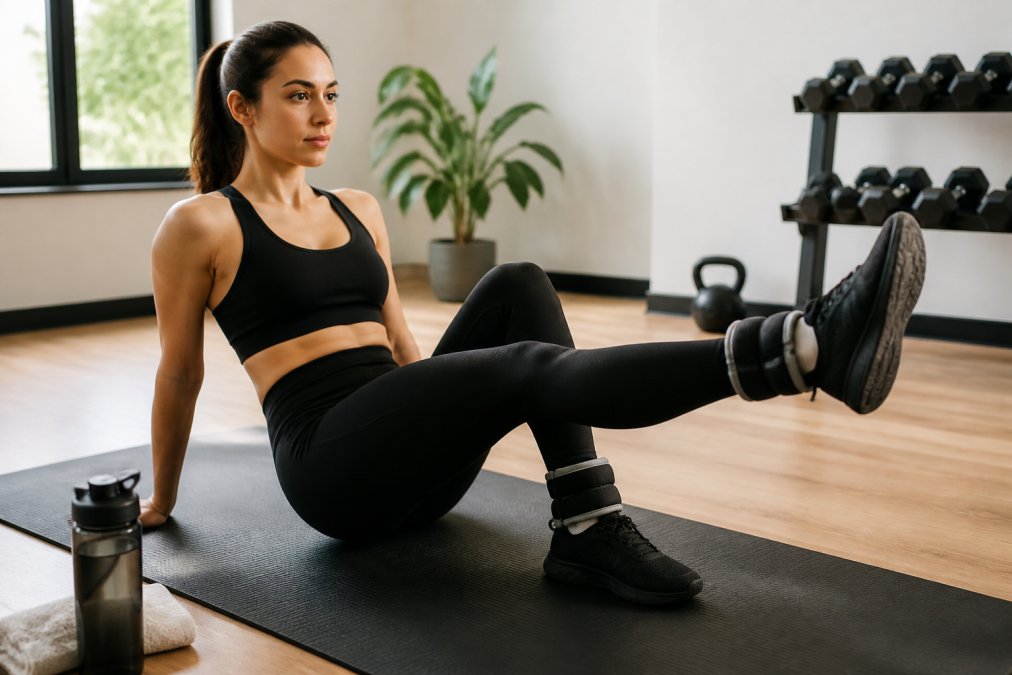
A simple progression that works:
- Week 1-2: Bodyweight only. Nail the movement pattern.
- Week 3-4: Add the lightest setting. Keep reps slow and controlled.
- Week 5+: Increase load only when the current weight feels easy for all sets.
Stop immediately if you feel your low back arching during leg lifts or your knee caving during step-ups. Those are signs the load is past what you can control.
Safety Tips for Weighted Fitness Gear Every Beginner Should Know
Safety tips for weighted fitness gear start with one rule: the weight should never dictate your form. If you can't complete the movement with the same control you had unweighted, the load is too high.
Other essentials:
- Warm up first. Cold muscles and added resistance don't mix.
- Check the strap. A band that shifts mid-rep pulls your joint out of line.
- Keep sessions short. Weighted bodyweight work is intensity, not volume.
- Watch the ankles. Avoid heavy ankle loading during running, which changes your stride.
- Progress slowly. Small jumps in load, not big ones.
The American Council on Exercise guidelines on resistance training recommend building movement quality before adding external load, which applies directly to wearable weights.
You can also cross-train with a [resistance band set(/products/rubber-resistance-band-set-with-door-anchor-ankle-strap-exercise-chart-and-resistance-band-carrying-case) | healthandfitnesscomp.com] to vary the resistance curve and reduce repetitive strain on the same joints.
Which Gear Fits Your Training Split?
The right choice depends on what your week already looks like. If your split is upper-body heavy, wrist bands add useful shoulder and arm work. If you're chasing glute and hip development, ankle weights are the more direct tool.
| Your Goal | Better Pick | Why |
|---|---|---|
| Upper body endurance | Wrist bands | Load sits near hands, hits shoulders and arms |
| Glute and hip work | Ankle weights | Long lever loads hips and glutes |
| Full-body circuits | Both | Alternate based on the movement |
| Walking or cardio | Light wrist bands | Ankle loading can alter stride |
| Beginner strength base | Neither yet | Build form first, add load later |
If you want one piece of gear that covers both, an adjustable set is the practical answer. The adjustable weighted fitness [wrist and ankle band(/products/adjustable-weighted-fitness-wrist-and-ankle-band) | healthandfitnesscomp.com] from Health and Fitness Company lets you dial the weight up or down and switch between wrist and ankle use, so you're not buying two separate products at $91.03. For beginners, that adjustability matters more than maximum load.
Conclusion
The real challenge with weighted gear isn't picking a side. It's matching the load to the movement so your form holds up rep after rep. Most people quit on wearable weights because they start too heavy, not because the tool doesn't work.
At Health and Fitness Company, we build gear for exactly that problem. Our adjustable weighted wrist and ankle band uses a silicone and steel construction that's waterproof and sweatproof, with an adjustable design that fits beginners and experienced athletes alike. Pair it with our rubber resistance band set for varied resistance across your full training week.
Get started with Health and Fitness Company and train with gear that adjusts to your level, not the other way around.
Frequently Asked Questions
Do wrist and ankle weights actually help with muscle toning?
Yes, but the effect is modest. Wrist bands and ankle weights add resistance to bodyweight movements, which increases muscle activation and calorie burn. Because the loads are light, typically 1 to 5 pounds per limb, they build muscular endurance and definition rather than raw size. Pair them with progressive bodyweight or dumbbell work for the best toning results.
Are adjustable wrist bands better for upper body workouts than ankle weights?
For upper body work, yes. Wrist bands sit close to the hands, so they add load to punches, arm circles, shadow boxing, and lateral raises without pulling on the shoulder joint. Ankle weights are designed for the lower body and can shift or rub when worn on the wrists. Adjustable wrist bands let you dial the weight up or down between sets, which keeps upper body toning sessions efficient.
How much weight should I start with for muscle toning?
Start with 1 to 2 pounds per limb and stay there for at least two weeks. The goal is to feel controlled resistance, not strain. Once the last few reps of an exercise feel easy, add half a pound to a pound. Adjustable bands make this easy because you can add or remove weight segments without buying a new set.
Can wearing ankle weights while walking cause joint injury?
It can if you jump straight into long walks with heavy loads. Ankle weights shift your center of gravity and add stress to the knees, hips, and lower back. Keep walks under 30 minutes, use 1 to 3 pounds per ankle, and land softly. Skip ankle weights entirely for running or plyometrics, since the added load multiplies impact forces on the joints.