Weighted Bands vs Weighted Vests for Training

Table of Contents
- Weighted Bands vs Weighted Vests: A Quick Comparison
- How Load Distribution Differs Between Bands and Vests
- The Benefits of Weighted Wrist Bands for Training
- Weighted Vest Safety Guidelines You Should Know
- Best Practices for Progressive Overload with Wearable Weights
- Bone Density, Joint Impact, and Long-Term Wearable Weight Use
- Choosing the Right Gear for Your Training Goals
- Conclusion: Weighted Bands vs Weighted Vests
- Frequently Asked Questions
Last Updated: September 24, 2026
Weighted Bands vs Weighted Vests: A Quick Comparison
Choosing between weighted bands and weighted vests for training comes down to one question: do you want load on your limbs or load on your torso? This guide from Health and Fitness Company breaks down exactly how each option changes your workout, so you can pick the right tool for your goals.

Weighted bands are wearable resistance tools worn on the wrists or ankles, adding small amounts of weight to your limbs during movement. Weighted vests distribute weight across your shoulders and chest, loading your center of mass instead. That single difference in load placement shapes everything else: how you move, how much weight you can safely add, and which exercises benefit most.
Here's the short version: bands suit dynamic, limb-driven work like walking, shadow boxing, and high-repetition bodyweight exercises. Vests suit whole-body loading during squats, push-ups, and stair-climber training. Below, we'll show you exactly how to match each tool to your training volume and experience level.
| Feature | Weighted Bands | Weighted Vests |
|---|---|---|
| Load placement | Wrists and ankles | Torso and shoulders |
| Typical weight range | Light, adjustable increments | Heavier, fixed or adjustable |
| Best for | Dynamic movement, cardio | Compound lifts, calisthenics |
| Impact on posture | Minimal | Requires core stability |
| Adjustability | High, per-limb tuning | Varies by model |
| Bulk during movement | Low | Moderate to high |
According to the American College of Sports Medicine's position stands on resistance training, progressive overload remains the foundational principle for building strength, whether you add load through a barbell, a vest, or wearable bands.
How Load Distribution Differs Between Bands and Vests
Load distribution is the single biggest technical difference between these two tools, and it changes your biomechanics in ways most buyers never consider.
Bands place resistance at the ends of your limbs. That means your postural muscles and core work less to stabilize the weight, while your arms and legs do more of the moving. Vests do the opposite: they load your trunk, so your core stability and spinal compression change immediately. A vest forces your kinetic chain to manage weight from the center outward.
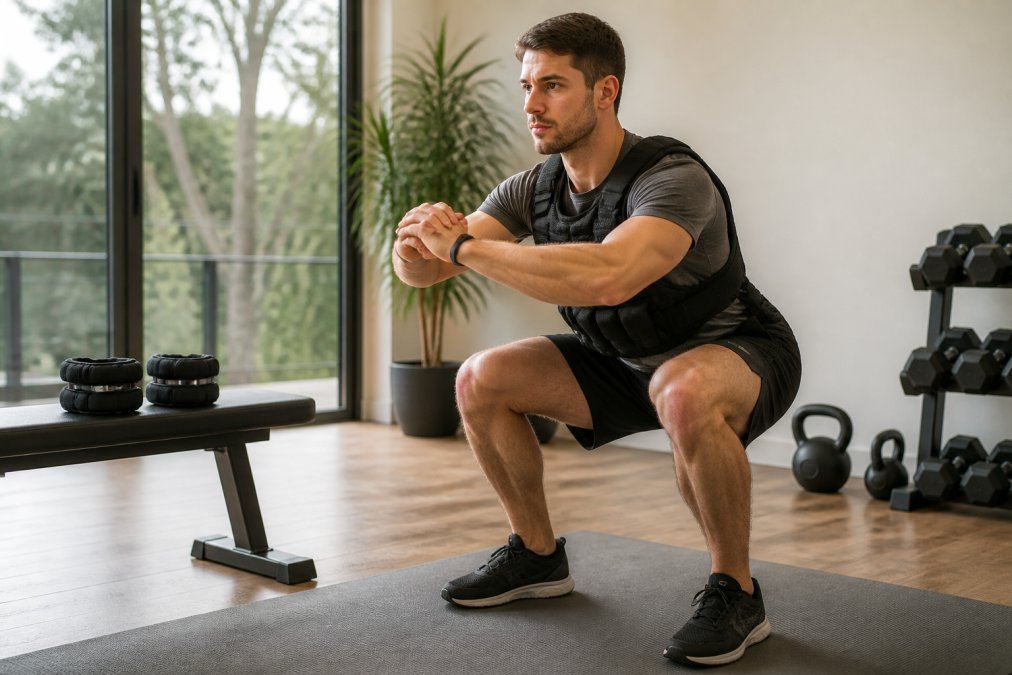
In practice, this means a weighted vest raises the demand on your hip-centered loading and trunk control during squats or lunges. Bands raise the demand on your shoulder and hip flexors during arm swings or leg lifts. Neither is "better." They simply stress different links in the chain.
The Benefits of Weighted Wrist Bands for Training
The benefits of weighted wrist bands center on convenience and joint-friendly progressive overload. They add resistance to movements you already do, without changing your setup or requiring a rack, bench, or spotter.
- Upper body resistance during cardio: Walking, jogging, and shadow boxing all get harder without heavier impact.
- Adjustable resistance: Most quality bands let you add or remove weight in small increments, which matters for beginners.
- Low barrier to entry: No learning curve. You strap them on and move.
- Versatility: Wrist bands double as ankle weights for leg lifts, glute work, and hip-centered loading.
Health and Fitness Company's Adjustable Weighted Fitness Wrist and Ankle Band is built from silicone and steel, so it resists sweat and holds its shape through repeated sessions. The adjustable design lets beginners start light and add resistance as strength-to-weight ratio improves.
What most guides miss is the grip problem. Cheap bands slip, shift, and lose tension mid-set, which throws off your range of motion. A band that stays put lets you focus on the movement instead of readjusting every thirty seconds.
Weighted Vest Safety Guidelines You Should Know
Weighted vest safety guidelines start with one rule: never add more than your joints and posture can control. A vest loads your spine directly, so poor form under load compounds fast.
Follow these basics:
- Start with the lightest available weight and add no more than 5-10% of body weight at a time.
- Keep the vest snug against your torso so it doesn't bounce during dynamic movement.
- Avoid wearing a vest for high-impact running until your core stability is solid.
- Skip vest work entirely if you have unresolved back or shoulder issues.
The National Academy of Sports Medicine's guidance on exercise safety and progression stresses mastering bodyweight movement patterns before adding external load. A vest is external load, plain and simple.
Adjustable Weighted Fitness Wrist and →
Best Practices for Progressive Overload with Wearable Weights
Progressive overload with wearable weights follows the same logic as any resistance program, increase demand gradually, track volume, and let recovery keep pace, but the mechanics differ sharply between bands and vests, and most guides gloss over that.
How bands progress. Weighted wrist and ankle bands typically advance in small increments (often 0.5 to 2 lb per segment on adjustable models). Because the load sits at the end of a long lever, your hand or foot, a 1 lb addition at the wrist can feel like a much larger jump than 1 lb added to a vest. A common pattern is to add one segment to one limb at a time, then let the other limbs catch up over the next two to three sessions. This keeps gait and swing mechanics symmetrical.
How vests progress. Vests advance in larger blocks, often 5, 10, or 20 lb plates or pouches.
A workable weekly framework:
- Weeks 1-2: Wear the gear at your current weight for all normal sessions. Log total volume (sets × reps × load).
- Weeks 3-4: Add one small increment to a single exercise, not the whole workout. For bands, that means one segment on one wrist. For vests, that means one plate or pouch.
- Weeks 5-8: Increase load only after you complete your target reps with clean form in two consecutive sessions. If form breaks, hold the load for another week.
- Weeks 9+: Rotate the increment across exercises so no single joint absorbs the jump every week.
The rehab angle most guides skip. Physical therapists commonly use light ankle and wrist weights for gait retraining, post-surgical knee and hip protocols, and rotator cuff progression because the load is easy to titrate in tiny steps. Weighted vests show up in PT settings too, but usually for balance and trunk-control work rather than limb strengthening. If you are returning from an injury, bands are almost always the lower-risk entry point, not because they are "safer" in the abstract, but because the increment size is smaller and the load never sits on the spine.
Bone Density, Joint Impact, and Long-Term Wearable Weight Use
Practical takeaway. Use a vest for controlled, low-impact compound movements where you want spinal and hip loading, squats, lunges, step-ups, carries. Use bands for high-repetition, low-impact work where you want limb loading without spinal compression, walking, arm swings, leg lifts, shadow boxing. Rotating between the two across a training week spreads the load across more tissue and reduces the cumulative strain on any single joint.
Choosing the Right Gear for Your Training Goals
Choosing the right gear comes down to matching the tool to the movement pattern you actually train. There's no universal winner in the weighted bands vs weighted vests debate, only a better fit for your program.
- Choose bands if: you do a lot of walking, running, calisthenics, or high-rep bodyweight work and want adjustable resistance without bulk.
- Choose a vest if: you train squats, push-ups, lunges, and stair-climber sessions and want torso loading.
- Choose both if: you want to load limbs and trunk across different sessions for full functional fitness coverage.
Conclusion: Weighted Bands vs Weighted Vests
The hard part isn't buying the gear. It's knowing which load your body actually needs, and adding it slowly enough that your joints and posture keep up.
Frequently Asked Questions
Are weighted wrist and ankle bands effective for increasing bone density?
Weighted bands add resistance to the arms and legs, which can support bone density when combined with progressive overload and weight-bearing movement. The load is lighter than a vest, so the skeletal stimulus is smaller. For meaningful bone density gains, pair bands with resistance training, walking, or stair-climber work, and increase weight gradually over weeks rather than jumping to heavy loads.
Is a weighted vest or weighted belt better for cardio and running?
A weighted vest distributes load across the torso, which keeps your center of gravity closer to normal during running and stair-climber training. A weighted belt concentrates load at the hips, which can shift your posture. For cardio, start with a vest at 5-10% of body weight and keep sessions under 30 minutes. Weighted bands are better suited to short intervals or walking than sustained running.
How do weighted bands differ from resistance bands in training?
Weighted bands add constant gravitational load to your wrists or ankles, so the resistance stays the same through the range of motion. Resistance bands create variable tension that increases as you stretch them. Weighted bands suit walking, running, and bodyweight exercises where you want steady added load. Resistance bands suit upper body resistance work and mobility drills where tension changes are useful.
How do you choose the right weight increment for wearable weights?
Start at 1-2% of your body weight for wrist bands and 2-5% for ankle bands, then add small increments every 1-2 weeks. For weighted vests, begin at 5% of body weight and cap at 10% for cardio. If your form breaks down, your range of motion shrinks, or joint stress shows up the next day, drop back one increment. Adjustable gear makes these small jumps easier than fixed-weight options.