Are Adjustable Ankle Weights Safe for Knees?

Table of Contents
- How Adjustable Ankle Weights Load the Knee Joint
- How to Use Ankle Weights Safely
- Exercises to Avoid with Knee Pain
- Ankle Weights for Physical Therapy and Rehabilitation
- Signs of Injury and When to Skip Wearable Resistance
- How to Choose Adjustable Ankle Weights for Knee Safety
- Conclusion: Making Smart Weighted Gear Choices
- Frequently Asked Questions
Last Updated: September 16, 2026
How Adjustable Ankle Weights Load the Knee Joint
Are adjustable ankle weights safe for knees? The short answer is yes, for most healthy people, when the load stays light and the movement stays controlled. The longer answer requires understanding one idea: the knee is a hinge joint sitting between two long levers, and where you place weight on those levers changes how much force travels through it.
This guide from Health and Fitness Company covers what that force does, how to use ankle weights safely, which exercises to avoid with knee pain, and how to pick a pair that supports rather than punishes your joints.
Distal loading is the term for adding resistance far from the body's center of mass, at the wrist or ankle rather than the torso. That distance is the whole story. A weight strapped below the knee swings through a longer arc than the same weight held at the hip, so the knee absorbs more torque at every step or repetition.
The Pendulum Effect, in Plain Terms
Imagine holding a one-pound weight against your hip and walking across a room. Now imagine strapping that same pound to your ankle. The weight is identical, but the second version feels dramatically heavier to your leg. That is the pendulum effect: the farther a mass sits from the joint that has to move it, the more torque that joint must produce to start, stop, and redirect it.
Torque is force multiplied by distance from the pivot. Move the weight twice as far from the knee and you roughly double the torque the knee has to manage, even though the number on the strap never changed. This is why a two-pound ankle weight can feel more demanding on the joint than a ten-pound dumbbell held close to the body during a squat.
That extra torque shows up in three places:
- The quadriceps must work harder to decelerate the swinging lower leg on every step.
- The patellar tendon absorbs repeated tension where the quadriceps attach to the shinbone.
- The ligaments (the ACL, MCL, and their neighbors) resist the small side-to-side and rotational forces that appear whenever the swinging weight changes direction.
Why the Knee Rarely Works Alone
Every movement travels through a chain of joints, and the knee sits in the middle of it. When you strap weight to your ankle, the hip and ankle have to compensate for the extra mass too, and that compensation changes your mechanics up and down the leg.
The knee also depends on more than muscle.
- Gait alteration: extra mass at the ankle changes your stride length and foot strike
- Ligament strain: sudden stops and direction changes load the collateral ligaments
- Tendonitis risk: the patellar tendon takes repeated stress with every step
- Joint alignment: uneven or excessive load can shift how the kneecap tracks
Fixed vs. Adjustable: Why the Increment Matters
Most articles talk about "ankle weights" as if every pair is the same. They are not, and the difference is directly relevant to knee safety.
How to Use Ankle Weights Safely
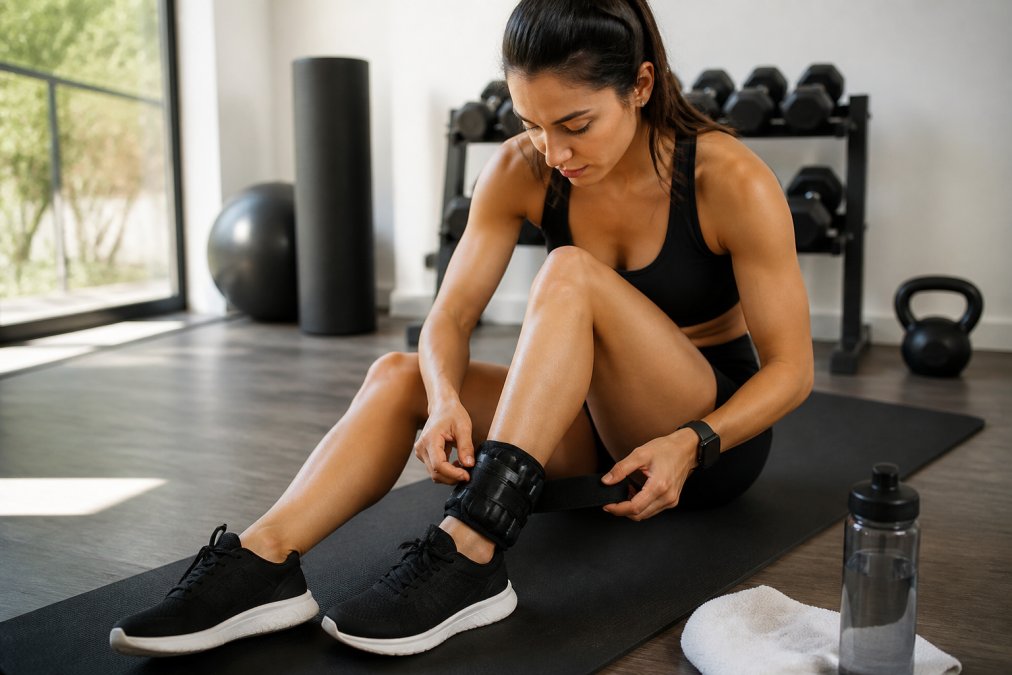
Safe use comes down to four variables: how much weight, how far from the joint, how fast you move, and how often you train. Get those right and the knee adapts. Get them wrong and you invite a repetitive stress injury.
- Warm up first. Five to ten minutes of light movement raises tissue temperature and prepares the joint.
- Check the fit. The strap should sit snug above the ankle bone without pinching or sliding.
- Control the tempo. Move slowly through each rep; momentum is what injures knees, not weight alone.
- Cap your session time. Twenty to thirty minutes is plenty for most accessory work.
- Cool down and stretch. Give the quadriceps, hamstrings, and calves time to relax.
Exercises to Avoid with Knee Pain
Some movements pair badly with ankle weights no matter how light the load. The reason is almost always the same: they combine distal weight with either impact, deep knee flexion, or fast direction changes, three conditions that concentrate force exactly where an irritated knee cannot absorb it.
| Unsafe with ankle weights | Why it stresses the knee | Safer alternative |
|---|---|---|
| Running or jogging | Repeated impact through a loaded, swinging joint | Walking or pool work without weights |
| Box jumps and jump squats | Landing force stacks on top of distal weight | Step-ups with no added load |
| Deep lunges | High shear on the patellar tendon at the bottom of the range | Shallow split squats with bodyweight only |
| Leg extensions with added weight | Isolated load at full extension, where the joint is least protected | Straight-leg raises lying down |
| High-knee drills | Fast, uncontrolled knee flexion under load | Slow marching in place, no weights |
| Lateral shuffles and pivots | Rotational force on the collateral ligaments | Controlled side-lying leg lifts |
The Pattern Behind the List
Every unsafe entry shares at least one of three traits:
Fitness Compression Knee Pad →
- Impact. The foot hits the ground and the force travels up through a joint that is already carrying extra mass.
- Deep flexion. The knee bends past roughly 90 degrees, which increases compression between the kneecap and the thighbone.
- Speed. Fast movement leaves no time to stop if something feels wrong, and momentum takes over from muscle control.
Safe Exercises to Use Instead
- Seated leg extensions (partial range). Sit in a chair, extend the knee only to about 45 degrees, and stop before full lockout.
- Lying straight-leg raises. Keep the knee straight and lift the whole leg; the hip does the work while the knee stays stable.
- Standing hip abduction. With the weight on the ankle, lift the leg out to the side slowly; the knee stays straight and the hip does the lifting.
- Slow marching in place. Lift each knee to about 45 degrees, pause, and lower with control.
- Seated knee flexion. From a chair, curl the heel back toward the seat slowly, keeping the range small.
An honest limitation here: even the safest exercise list cannot rescue a joint that is already inflamed. If your knee is swollen or painful at rest, the weight comes off and a clinician takes over.
Ankle Weights for Physical Therapy and Rehabilitation
Ankle weights are a genuine tool in physical therapy and rehabilitation, but the dosage matters more than the device. Clinicians use them for controlled strengthening of the quadriceps, hamstrings, and hip muscles, often in seated or lying positions where the joint stays supported.
Signs of Injury and When to Skip Wearable Resistance
Your knee will tell you when the load is too much, usually before any real damage occurs. The skill is recognizing the early signals and acting on them.
Watch for these warning signs:
- Pain that appears during the movement and fades at rest
- Swelling or warmth around the joint after a session
- Aching that lingers into the next day
- Clicking or catching that was not there before
- A feeling that the knee might give way
How to Choose Adjustable Ankle Weights for Knee Safety
Adjustable weight increments are the single most important feature for knee safety, and most buyers overlook it. A fixed 5-pound strap gives you one option; an adjustable band lets you start at 1 pound and add resistance in small steps as your knee tolerates more.
Look for these qualities:
- Incremental loading. Small, removable segments let you fine-tune the load.
- Secure, wide straps. A band that shifts mid-movement creates sudden, uncontrolled torque.
- Comfortable lining. Pressure points distract you from form and encourage compensations.
- Durable materials. Waterproof, sweat-resistant construction holds up to repeated sessions.
Conclusion: Making Smart Weighted Gear Choices
The real question is not whether ankle weights are dangerous, but whether your load, tempo, and exercise choices match what your knees can handle today. Get that balance right and distal loading becomes a useful tool for building strength and stability.
Frequently Asked Questions
Is there a downside to wearing ankle weights?
Yes, the main downside is added stress on knee and hip joints because the weight sits far from your core. This distal loading increases torque on the knee, especially during fast movements. Adjustable ankle weights let you start light and progress gradually, but overloading or using them during high-impact activities can lead to ligament strain, tendonitis, or muscular imbalance. Always follow safe weight limits and proper form.
Will wearing ankle weights strengthen the knees?
Ankle weights can strengthen the muscles around the knee, such as the quadriceps and hamstrings, when used correctly in controlled, low-impact exercises. This added muscle support can improve joint stability. However, they do not directly strengthen ligaments or tendons and may strain them if you use too much weight or perform high-impact moves. For knee strengthening, pair light adjustable ankle weights with slow, controlled leg lifts and physical therapy guidance.
What are the pros and cons of adjustable ankle weights?
Pros include customizable resistance for progressive overload, versatility for many exercises, and convenience for home workouts. Cons include potential knee joint stress from distal loading, risk of poor form if you add weight too quickly, and limited use during high-impact activities. Adjustable ankle weights are safer than fixed weights because you can fine-tune increments, but they still require careful exercise selection and gradual progression to protect your knees.
Do physical therapists recommend ankle weights for knee rehabilitation?
Physical therapists often use ankle weights for knee rehabilitation, but only for specific low-impact exercises like straight leg raises, terminal knee extensions, and seated leg lifts. They typically prescribe light weights and monitor for pain. For conditions like patellofemoral syndrome or post-surgery recovery, a therapist will set safe weight limits and may combine ankle weights with other resistance tools. Always get clinical guidance before starting a rehab routine with ankle weights.