Best Adjustable Ankle Weights for Fitness

Table of Contents
- What to Look for in Adjustable Ankle Weights
- How to Use Ankle Weights Safely
- Benefits of Ankle Weights for Walking
- Ankle Weights for Physical Therapy and Rehabilitation
- Top Adjustable Ankle Weight Options
- Material Quality and Durability
- Choosing the Right Weight Capacity
- Conclusion
Last Updated: August 14, 2026
What to Look for in Adjustable Ankle Weights
When shopping for adjustable ankle weights, you're making a decision that affects both your safety and your training results. The right pair supports progressive overload, maintains proper gait mechanics, and won't fall apart after consistent use.
Start with weight capacity. Most adjustable ankle weights range from 1 to 10 pounds per ankle. Beginners typically start with 1-3 pounds per ankle, while experienced lifters may need 5-10 pounds. The beauty of adjustable designs is that you grow into them without outgrowing your investment.
Next, examine the closure system. Quality velcro maintains tension through sweat and repeated fastening cycles, while cheap velcro loses grip after 20-30 uses. A secure fit prevents weights from shifting during leg lifts or lateral movements, which can throw off your gait mechanics and increase joint stress.
Material quality separates products that last from those that don't. Neoprene padding should be at least 0.5 inches thick to cushion without bunching. The outer fabric should be breathable and sweat-wicking to prevent skin irritation. Double-stitched seams hold up; single stitching fails.
Weight distribution matters significantly. Weights should sit evenly around your ankle rather than clustering on one side. Uneven distribution creates biomechanical stress and can lead to ankle instability or knee pain. Look for designs that wrap the entire ankle area.
Finally, consider the adjustability mechanism. Some weights use removable sand packets; others use internal compartments with adjustable loads. Internal systems are more stable and work better for progressive overload training, allowing you to add or remove weight without fussing with external components.
How to Use Ankle Weights Safely
Using ankle weights safely requires understanding how they change your movement patterns and joint loading. Improper use can lead to ankle instability, knee pain, or lower back strain.

Begin with lighter weights than you think you need. Start at 1-2 pounds per ankle and perform your chosen exercise for a full session. If you finish without form breakdown, that's your baseline. Form breakdown, when your body compensates by using different muscle groups or changing your gait, signals that the weight is too heavy.
Warm up before adding ankle weights. Five minutes of light cardio followed by dynamic leg stretches prepares your joints and muscles. Ankle weights increase joint stress, particularly at the ankle and knee.
Progressive Overload and Weight Increments
Progressive overload is the principle of gradually increasing training stress to continue building strength and endurance. With ankle weights, progression happens through adding weight, increasing reps, increasing sets, or reducing rest between sets.
The safest progression is adding weight in small increments. Move from 2 pounds to 3 pounds, not 2 to 5. Small jumps of 0.5 to 1 pound allow your joints to adapt without sudden stress spikes. Give yourself at least 2-3 weeks at each weight level before progressing, allowing your connective tissue to strengthen alongside your muscles.
Track your workouts. Note the weight, exercise, reps, and how you felt. Muscle soreness is normal; sharp joint pain is not. The distinction matters for injury prevention.
Gait Mechanics and Form Considerations
Ankle weights change how your body moves, increasing demand on your hip flexors, glutes, and core. Poor form compounds this demand and creates injury risk.
For walking with ankle weights, maintain upright posture with your core engaged. Your stride should feel natural, not exaggerated. Longer strides increase impact and joint stress without adding training benefit.
For leg lifts and standing exercises, keep your supporting leg straight but not locked. Perform movements slowly and with control. Swinging weights creates momentum, reducing muscle engagement and increasing injury risk. Each rep should take 2-3 seconds up and 2-3 seconds down.
For seated exercises, maintain neutral spine alignment. Avoid rounding your lower back or leaning backward to keep stress on target muscles rather than your spine.
Benefits of Ankle Weights for Walking
Walking with ankle weights transforms a low-intensity activity into a resistance training session, building lower body strength and endurance without requiring a gym.
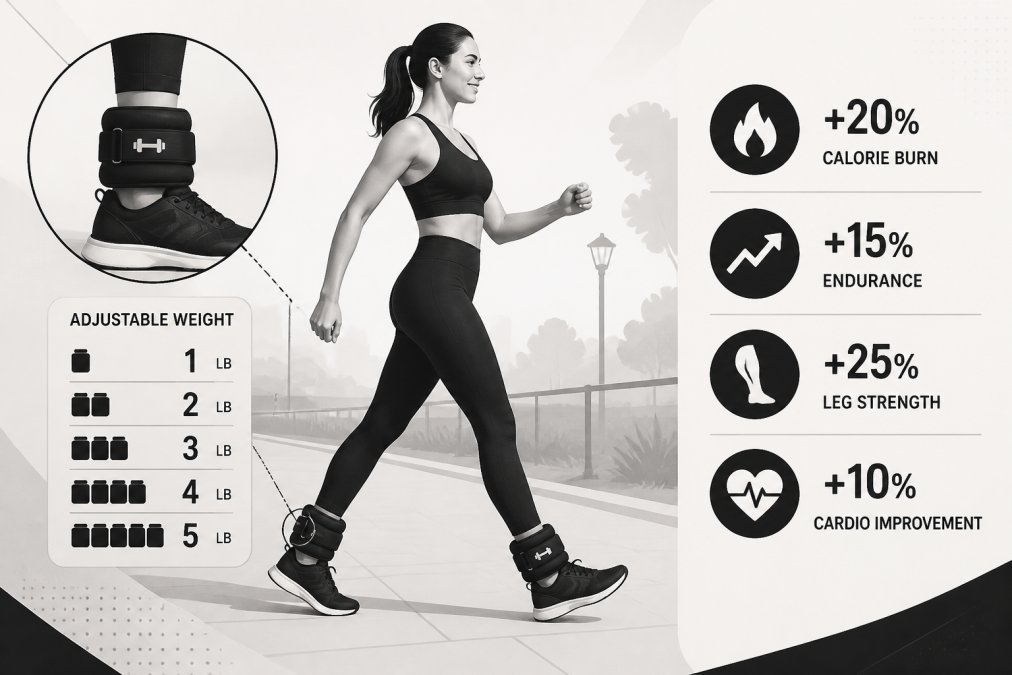
The primary benefit is increased muscle engagement. Adding weight forces your hip flexors, glutes, quadriceps, and calves to work harder, building muscle hypertrophy and strength endurance over time.
Cardiovascular endurance improves alongside strength. Walking with added weight elevates your heart rate more than unweighted walking at the same pace, providing dual benefits of strength and cardiovascular work.
Joint stability improves with consistent use. Your ankles, knees, and hips adapt to added load by strengthening stabilizer muscles, reducing fall risk and improving athletic performance.
Calorie expenditure increases. Walking with 5-pound ankle weights burns approximately 5-10% more calories than unweighted walking, depending on pace and individual factors.
For beginners, weighted walking is less intimidating than gym-based resistance training. The familiar movement pattern reduces the learning curve, making it easier to maintain consistent training.
Ankle Weights for Physical Therapy and Rehabilitation
Ankle weights serve important roles in physical therapy and rehabilitation settings, helping restore strength after injury and supporting recovery from surgery.
In rehabilitation, ankle weights provide controlled resistance for isolated muscle groups. After an ankle sprain, a physical therapist may prescribe ankle weight exercises to restore strength to ankle stabilizers. The adjustable nature allows precise load management as healing advances.
For knee rehabilitation, ankle weights add resistance to leg lifts and movements that strengthen the quadriceps and hip muscles. Stronger quads stabilize the knee, reducing stress on injured tissues.
Ankle weights support balance training in rehabilitation by challenging your proprioceptive system. This challenge builds the neuromuscular control needed to prevent future injuries.
Always consult a physical therapist before using ankle weights in rehabilitation. They'll prescribe specific exercises, weight ranges, and progression timelines based on your injury and recovery stage.
Top Adjustable Ankle Weight Options
Health and Fitness Company Adjustable Weighted Fitness Wrist and Ankle Band
Health and Fitness Company's Adjustable Weighted Fitness Wrist and Ankle Band stands out for precision engineering and durability, delivering quality support for beginners and experienced athletes alike.

The design features industrial-grade velcro that maintains grip through sweat and repeated use. The neoprene padding is thick enough to cushion without bunching, and the breathable fabric prevents skin irritation during longer sessions.
Weight adjustment is straightforward through internal compartments that let you fine-tune load in small increments, supporting progressive overload training. The secure fit keeps weights positioned correctly around your ankle, distributing force evenly and reducing joint stress.
At $91.03 per pair, these represent a mid-range investment. For serious trainees committed to progressive overload training, the durability and adjustability justify the price.
Pros:
- Industrial-grade velcro maintains grip through extended use
- Thick neoprene padding provides comfort and impact reduction
- Fine-tuned weight adjustment supports progressive overload
- Secure, even weight distribution improves biomechanics
- Breathable fabric reduces skin irritation
Cons:
- Higher price point than basic ankle weights
- Requires initial fitting to find your ideal weight range
- Heavier than minimalist designs
Resistance Band Set with Door Anchor, Ankle Strap, Exercise Chart, and Resistance Band Carrying Case
Health and Fitness Company's Rubber Resistance Band Set offers versatility beyond traditional ankle weights. The ankle strap attachment lets you convert resistance bands into ankle weight alternatives. Resistance bands provide variable resistance, with tension increasing as you stretch further, potentially offering greater strength gains than fixed-weight ankle weights.
The set's versatility is its main advantage. You can use bands for upper body, lower body, or core training. The included exercise chart provides guidance on proper form, and the carrying case enables portable training.
At $33.66, this set costs significantly less than dedicated ankle weights, representing good value for budget-conscious trainees exploring ankle weight training.
Pros:
- Variable resistance recruits more muscle fibers
- Multi-purpose for upper and lower body work
- Affordable entry point for exploring ankle weight training
- Included exercise chart supports proper form
- Carrying case enables portable training
Cons:
- Less stable than fixed-weight ankle weights during dynamic movements
- Ankle strap may slip during intense exercises
- Requires more active stabilization from your joints
- Not ideal for precise progressive overload increments
Material Quality and Durability
Material quality determines how long your ankle weights last and how safely they perform. Cheap materials fail quickly and create injury risk when weights slip during use.
Neoprene padding quality varies widely. Premium neoprene is thick (at least 0.5 inches) and maintains cushioning through hundreds of uses. Budget neoprene compresses after 50-100 uses, losing cushioning and comfort.
Velcro quality is equally critical. Industrial-grade velcro maintains grip through repeated fastening cycles and sweat exposure. When velcro fails, weights slip during exercise, creating safety hazards. Look for "heavy-duty" or "industrial-grade" specifications.
Stitching determines how long straps and padding stay attached. Double-stitched seams hold through years of use; single stitching fails within months.
The outer fabric should be durable and sweat-wicking. Polyester blends offer good durability and moisture management. Breathable fabrics prevent skin irritation and extend product lifespan by reducing mold and mildew growth.
Weight distribution design affects durability. Designs spreading weight across the entire ankle experience less localized stress than designs concentrating weight on one side.
Choosing the Right Weight Capacity
Your ideal weight capacity depends on your fitness level, goals, and experience with resistance training.
Beginners should start with ankle weights offering a maximum capacity of 3-5 pounds per ankle. This range provides enough resistance to build initial strength without overwhelming your joints.
Intermediate lifters typically need 5-10 pounds per ankle. If you've trained with ankle weights for several months or have general strength training experience, this range supports progressive overload.
Advanced lifters may want capacity beyond 10 pounds per ankle, though most people don't need this. Ankle weights become less practical above 10 pounds.
Consider your specific goals. For cardiovascular endurance training during walking, 2-5 pounds per ankle is sufficient. For strength building through leg lifts, 5-10 pounds is more appropriate.
Your body weight matters too. Heavier individuals can typically handle more weight than lighter individuals without excessive joint stress.
Progressive overload requires capacity beyond your starting weight. If you begin at 2 pounds and want to progress over 6 months, you need capacity for at least 5-6 pounds.
Ankle weights are powerful tools for building lower body strength, improving cardiovascular endurance, and supporting rehabilitation. The right pair, like Health and Fitness Company's Adjustable Weighted Fitness Wrist and Ankle Band, combines precision engineering with durable materials designed to support your fitness goals for years. Start with conservative weight, progress gradually, and prioritize proper form over heavy loads. Your joints will thank you, and your results will follow. Get started with Health and Fitness Company and experience how precision-engineered ankle weights help your training journey.

Frequently Asked Questions
Are adjustable ankle weights good for building muscle?
Yes. Adjustable ankle weights add resistance to lower body exercises, which triggers muscle hypertrophy when combined with progressive overload. By increasing weight increments gradually, you create the tension needed for glute activation, leg lifts, and core engagement. Start with lighter weights and progress systematically to avoid joint stress while maximizing strength endurance gains.
How do I use ankle weights safely during walking?
Maintain upright posture and normal gait mechanics when wearing ankle weights for walking. Start with 1-2 pounds per ankle and increase gradually. Wear them for 20-30 minutes initially, focusing on smooth, controlled movements. Ensure secure fit with velcro closure to prevent shifting. If you experience knee or hip discomfort, reduce weight or duration immediately.
Can adjustable ankle weights be used on wrists too?
Many adjustable ankle weights, including the Health and Fitness Company Adjustable Weighted Fitness Wrist and Ankle Band, work on both wrists and ankles. Check the product specifications for weight range and closure type. Wrist weights are effective for upper body resistance training and cardiovascular endurance work, making them versatile fitness accessories for home gym equipment.
What weight range should I look for in adjustable ankle weights?
Beginners should start with 1-5 pounds per ankle and progress to 5-10 pounds as strength improves. Intermediate users typically work with 10-20 pounds. Advanced athletes may use 20+ pounds for specific resistance training goals. Choose adjustable designs with multiple weight increments so you can increase load progressively without buying new equipment repeatedly.
Are there safety risks when using ankle weights for walking?
Overuse can stress the knees, hips, and ankles, particularly if you jump to heavy weights too quickly. Avoid high-impact activities like running with ankle weights until you build adequate joint stability. Ensure neoprene padding and breathable fabric to prevent skin irritation during extended wear. Listen to your body and reduce weight if you experience joint pain.
This article was written using GrandRanker