Do Wrist Weights Ruin Workout Form? A Biomechanics Guide

Table of Contents
- How Wrist Weights Change Your Biomechanics
- Impact of Wrist Weights on Joint Health
- Wrist Weights vs. Dumbbells for Strength Training
- How to Use Wrist Weights Safely
- Common Form Mistakes and How to Fix Them
- Recovery and Injury Prevention With Wrist Weights
- The Bottom Line on Wrist Weights and Form
Last Updated: August 24, 2026
How Wrist Weights Change Your Biomechanics
When you add weight to your wrists, you're not just increasing resistance, you're fundamentally altering how your entire kinetic chain moves. The core issue revolves around distal loading, placing weight at the furthest point from your body's center. Your arms swing naturally during running and cardio exercises. Add 5 pounds to each wrist, and that natural pendulum motion becomes heavier, slower, and harder to control. Your body compensates by recruiting stabilizer muscles differently, changing your stride, and shifting how force travels through your joints.

Distal loading and arm swing mechanics
Distal loading places resistance at your wrists and hands rather than at your core or torso. This matters because your arm swing counterbalances your lower body, stabilizes your spine, and helps propel you forward. When you add weight to that system, the mechanics change immediately.
A 5-pound wrist weight creates significant additional demand on your rotator cuff muscles and shoulder stabilizers (peer-reviewed research). These muscles fatigue faster, leading to compensatory movement patterns as your body finds workarounds to complete the same motion with less effort from fatigued muscles. Heavier arms swing slower and with less natural rhythm. Many people unconsciously reduce their arm swing range to minimize effort, which changes posture and reduces the counterbalancing effect. This can lead to increased spinal rotation and less efficient movement overall.
Compensatory movements and posture breakdown
When your body encounters new resistance, it adapts. Sometimes those adaptations are positive; often they're negative, increasing injury risk.
Common compensatory patterns with wrist weights include forward shoulder lean, excessive trunk rotation, and reduced hip extension. Your shoulders might creep forward as your upper back fatigues, your torso might twist more to generate momentum, and your hip drive might weaken because your core is working overtime to stabilize the additional load at your wrists.
Postural alignment breaks down when these compensations stack. A forward shoulder lean compresses the anterior shoulder joint and can trigger shoulder impingement syndrome. Excessive trunk rotation places shear stress on your lumbar spine. Reduced hip extension means your glutes aren't firing fully, affecting your knee tracking and ankle stability. The progression is predictable: add weight → primary muscles fatigue → compensatory patterns emerge → poor posture develops → injury risk increases.
Impact of Wrist Weights on Joint Health
Wrist weights create concentrated stress on the joints that support them. Your wrists, elbows, and shoulders weren't designed to handle repetitive loading at the extremities for extended periods.
Rotator cuff and shoulder strain
Your rotator cuff is a group of four muscles and tendons that stabilize your shoulder joint. Wrist weights increase the demand on your rotator cuff significantly. When you wear 3-5 pounds on each wrist during arm swings, your rotator cuff muscles must work harder to control the arc of motion and prevent excessive shoulder joint movement (peer-reviewed research). Over time, this increased demand can lead to tendonitis, inflammation of the tendons that attach these muscles to bone.
Rotator cuff strain typically develops gradually, progressing from mild shoulder discomfort during workouts to sharp pain during specific movements and eventually chronic issues that limit your range of motion. Recovery from rotator cuff injuries can take months (the NIH). Prevention is far simpler: start with lighter weights (1-2 pounds), maintain strict form, and stop immediately if you feel sharp shoulder pain.

Elbow and wrist joint stress
Your elbows and wrists bear the direct load of wrist weights. Unlike your shoulders, which have multiple muscle groups to distribute stress, your wrist and elbow joints rely on smaller muscles and tendons that fatigue quickly.
Repetitive stress on the wrist joint can trigger tendonitis in the extensor carpi radialis tendons, causing pain on the outer side of your elbow. Wrist joint stress manifests as pain during wrist extension or flexion, swelling, or a clicking sensation. The wrist joint is particularly vulnerable because most stability comes from ligaments and tendons, not muscle. Wrist weights can create instability if you lack adequate grip strength and wrist stabilizer development before adding load.
Wrist Weights vs. Dumbbells for Strength Training
Load distribution and muscle engagement
Dumbbells concentrate weight in your hands, creating a more stable, controlled load that you can grip and position precisely. Wrist weights distribute load along your wrists and lower forearms, a more distributed but less controllable load that you can't adjust mid-movement.
For strength training, dumbbells are superior because they allow you to isolate muscle groups more effectively. A dumbbell curl isolates your biceps with minimal stabilizer involvement. A wrist weight worn during the same motion engages stabilizer muscles more heavily because the weight is further from your body. Muscle engagement with wrist weights is more distributed but less focused, useful for functional fitness and metabolic conditioning but less useful for isolated strength development.
Range of motion and exercise variety
Dumbbells allow for a wider range of motion and greater exercise variety. You can perform curls, presses, raises, and dozens of other movements. Wrist weights are more limited, you wear them and perform your existing exercise. Your range of motion is also constrained because the weight is fixed to your wrist.
For progressive overload, dumbbells are more flexible. You can increase weight in small increments, perform additional sets or reps, or change tempo. With wrist weights, your main progression options are adding more weight or wearing them longer, which may plateau in effectiveness faster.
How to Use Wrist Weights Safely
If you decide to use wrist weights, following a structured approach minimizes injury risk and maximizes benefits.
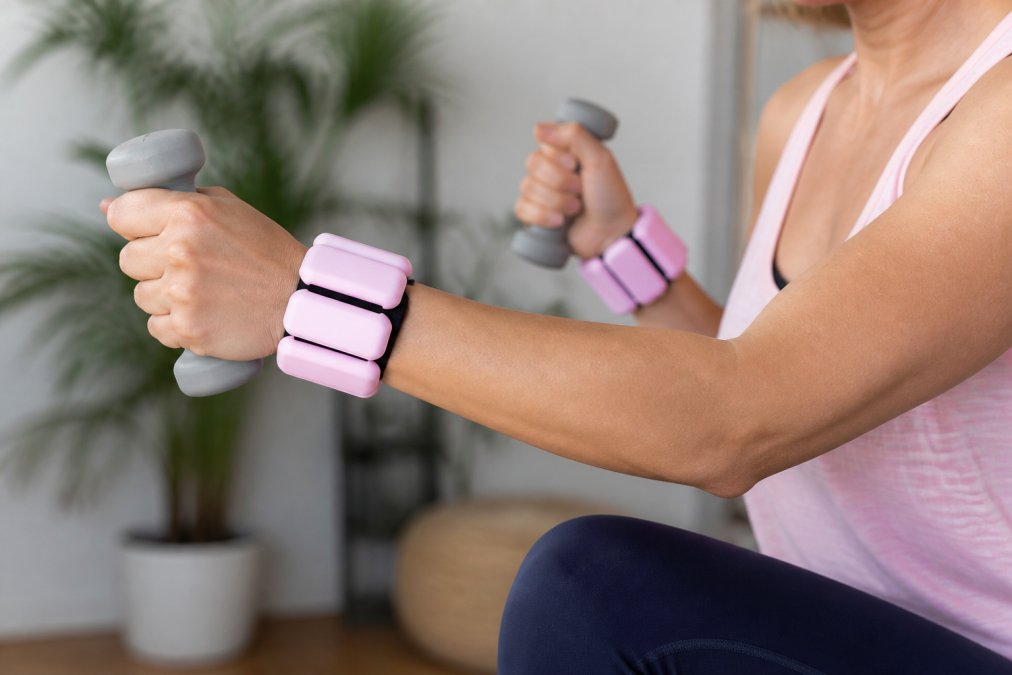
Starting weight guidelines (1lb vs. 5lb)
Your starting weight should be based on your current fitness level. Most beginners should start with 1-pound wrist weights, not 5 pounds.
A 1-pound weight per wrist is light enough that it won't significantly disrupt your form during cardio or basic strength exercises. It provides enough resistance to feel added demand on your muscles and cardiovascular system, but light enough that your stabilizer muscles can adapt without becoming overwhelmed. After 2-3 weeks of consistent use with 1-pound weights, you'll develop the connective tissue strength and neuromuscular control necessary to progress.
Five-pound wrist weights are appropriate for intermediate to advanced athletes who have already trained with lighter weights and developed adequate shoulder stability and grip strength. Jumping directly to 5 pounds significantly increases injury risk.
The progression should follow this timeline:
- Weeks 1-3: 1-pound weights, 3-4 sessions per week, 20-30 minute duration
- Weeks 4-6: 1.5-2 pound weights, same frequency and duration
- Weeks 7-10: 2-3 pound weights, gradually increasing duration to 45 minutes
- Weeks 11+: 3-5 pound weights, based on how your joints respond
Form checkpoints and progressive overload
Before each session wearing wrist weights, perform these form checks:
-
Shoulder position: Your shoulders should sit back and down, not elevated toward your ears.
-
Arm swing: Your arm swing should feel natural and controlled without excessive trunk rotation or reduced range of motion.
-
Posture: Maintain a neutral spine with your core engaged, avoiding forward shoulder lean.
-
Wrist alignment: Your wrist should be neutral, not bent forward or backward.
-
Grip strength: Your grip should be firm but not tense.
Progressive overload with wrist weights happens in this order: First, increase duration before adding more resistance. Second, increase frequency from 3 to 4 to 5 sessions per week. Third, increase the weight only after using your current weight for at least 3-4 weeks without pain. Never increase weight and duration simultaneously.
Common Form Mistakes and How to Fix Them
Most injuries from wrist weights stem from preventable form mistakes.
Excessive arm swing and momentum
Many people unconsciously increase their arm swing when wearing wrist weights, using momentum to reduce muscular effort. This increases torque on your shoulder joints, reduces exercise effectiveness, and changes your gait pattern.
Your arms should swing at approximately a 90-degree angle at the elbow, with movement primarily at the shoulder joint. Your swing should match your stride. If you notice yourself using momentum, reduce the weight or remove the wrist weights until you can maintain control. Record yourself from the side view, your arm swing should look nearly identical to your arm swing without weights, just slightly slower and more controlled.
Forward shoulder lean and postural alignment
Forward shoulder lean is one of the most common compensatory patterns when using wrist weights. Your shoulders creep forward as your upper back fatigues from stabilizing the additional load.
This position compresses your anterior shoulder joint and can trigger shoulder impingement syndrome. The fix requires conscious posture correction during every rep or stride. Before putting on wrist weights, practice perfect posture without them. Your shoulders should be packed back and down, your chest open, and your spine neutral. When you add wrist weights, maintain this exact posture. If you can't hold it, the weight is too heavy or you've exercised too long.
Recovery and Injury Prevention With Wrist Weights
Using wrist weights safely extends beyond the workout itself.
Connective tissue adaptation and rest days
Connective tissue, tendons, ligaments, and cartilage, adapts to stress more slowly than muscle. Your muscles recover in 24-48 hours, but your connective tissue requires 48-72 hours. This is why rest days are non-negotiable when training with wrist weights.
Connective tissue strengthens through collagen remodeling. When you stress a tendon or ligament, your body initiates a repair process that strengthens the tissue. However, this process requires rest. If you stress the same tissue again before it's fully adapted, you create micro-tears that accumulate into tendonitis.
Use wrist weights no more than 4 days per week, with at least one full rest day between sessions. On non-wrist-weight days, avoid exercises that stress the same joints heavily. Active recovery on rest days, light stretching, foam rolling, and mobility work, accelerates adaptation by improving blood flow to your joints and tendons.
Integrating wrist weights with fitness trackers
When you first start using wrist weights, track your heart rate during the same exercise with and without them. You'll likely see a 5-10% increase in heart rate at the same pace, confirming that wrist weights increase cardiovascular demand. Use this data to adjust your intensity appropriately.
Some advanced trackers measure arm swing patterns and movement symmetry. Use this data to catch form breakdown early. If your tracker shows that your left arm is swinging differently than your right, these are signs that compensatory movements are developing. Address the issue immediately by reducing weight or duration.
Wrist-based fitness trackers may give inaccurate readings when you're wearing wrist weights on the same wrist. If possible, wear wrist weights on one wrist and your tracker on the other, or use a chest-based heart rate monitor instead.
The Bottom Line on Wrist Weights and Form
Do wrist weights ruin workout form? The answer depends entirely on how you use them. Wrist weights placed on your wrists without proper preparation, progressive loading, and form awareness will almost certainly degrade your movement quality and increase injury risk.
Used correctly, starting with conservative weights, maintaining strict form, progressing gradually, and prioritizing recovery, wrist weights can enhance your training without compromising your biomechanics. Most injuries from wrist weights are preventable. They result from starting too heavy, progressing too quickly, or ignoring early warning signs like shoulder discomfort or postural breakdown. If you experience sharp pain, persistent soreness, or noticeable form degradation, stop using wrist weights immediately.
For athletes at Health and Fitness Company, we've designed our Adjustable Weighted Fitness Wrist and Ankle Bands specifically to address these concerns. The adjustable design lets you start with conservative weights and progress systematically without jumping between fixed increments. The precision engineering ensures the weight is distributed evenly across your wrist, reducing concentrated stress on any single joint. Most importantly, the adjustable feature removes the excuse to progress too quickly, you can add weight in small increments only when your body is ready.
Frequently Asked Questions
Are wrist weights damaging to joints?
Wrist weights are not inherently damaging, but improper use increases joint stress. The distal loading created by wrist weights places additional strain on the rotator cuff, elbow, and wrist joints. Starting with 1-2 lb and maintaining strict form prevents tendonitis and joint inflammation. Gradual progression and rest days allow connective tissue to adapt. If you experience sharp pain, reduce weight immediately and consult a healthcare provider.
How do wrist weights affect your center of gravity during cardio?
Wrist weights shift your center of gravity forward and increase momentum during arm swing, which can cause compensatory movements in your shoulders and lower back. To maintain biomechanical integrity, keep your arms at 90 degrees, limit arm swing to waist height, and engage your core. This prevents postural breakdown and reduces injury risk. Beginners should focus on controlled movement before increasing weight.
Are wrist weights better than dumbbells for strength training?
Wrist weights and dumbbells serve different purposes. Dumbbells offer greater range of motion, load flexibility, and muscle isolation, making them superior for hypertrophy and functional fitness. Wrist weights excel at adding resistance to cardio and bodyweight exercises without requiring hand grip. For pure strength training, dumbbells are the better choice. Wrist weights complement cardio workouts and upper body conditioning when form is prioritized.
Will wearing wrist weights build muscle or just cause injury?
Wrist weights can build muscular endurance and support hypertrophy when used correctly with progressive overload and proper form. The key is starting light (1-2 lb), maintaining postural alignment, and increasing weight gradually over weeks. Poor form leads to compensatory movement and injury instead of muscle gains. Pair wrist weights with strength training and adequate recovery to see results. Quality of movement always outweighs quantity of weight.
Wrist weights can be a valuable training tool, but only when you approach them with respect for biomechanics and a commitment to form. Start light, progress conservatively, and listen to your body. The Health and Fitness Company's adjustable wrist weights give you the control to do exactly that, supporting your strength training goals while protecting your joints and maintaining your movement quality.
This article was written using GrandRanker