Is 20 Minutes of Resistance Training Daily Enough?

Table of Contents
- The Short Answer: It Depends on Your Goals
- How Long Should a Strength Training Session Be?
- Resistance Training Frequency: How Often Per Week?
- Building a 20-Minute Workout With Weights
- Progressive Overload for Beginners: Growing Stronger Over Time
- Weekly Training Volume and Recovery
- Common Mistakes With Short Workouts
- Conclusion
- Frequently Asked Questions
Last Updated: October 6, 2026
The Short Answer: It Depends on Your Goals
Whether 20 minutes of resistance training 20 minutes daily is enough depends entirely on what you're trying to achieve. For maintaining muscle and general fitness, it can work. For building significant strength or muscle mass, you'll likely need more volume or higher intensity.
Most people assume more hours always equals better results. That's not how resistance training works. A focused 20-minute session with proper exercise selection, intensity, and progression can deliver real benefits. But the same 20 minutes done casually won't move the needle.
At Health and Fitness Company, we work with athletes and fitness enthusiasts who face real time constraints. The question isn't whether 20 minutes is enough in theory, it's whether it's enough for YOUR specific goal, training frequency, and recovery capacity.
How Long Should a Strength Training Session Be?
The ideal strength training session length ranges from 45 to 90 minutes for most people. However, effective sessions can happen in as little as 20 to 30 minutes when structured properly. Research and practical experience show that session length matters far less than exercise selection and intensity.
A 20-minute resistance training session works best when you:
- Focus on compound exercises (movements that train multiple muscle groups)
- Use challenging weight that limits you to 6-12 repetitions per set
- Keep rest periods short (60-90 seconds between sets)
- Eliminate warm-up time or keep it under 3 minutes
The trade-off is clear: shorter sessions demand higher intensity and better exercise choice. You can't do as many exercises, so every movement must count. This actually forces better decision-making than longer, unfocused workouts.
Resistance Training Frequency: How Often Per Week?
Most people see solid results training 3 to 4 days per week. This frequency allows enough volume to build strength and muscle while leaving time for recovery. If you're doing 20-minute sessions, frequency becomes even more important, you need multiple sessions to accumulate enough weekly volume.
Training the same muscle groups 2 times per week is a baseline for progress. Training 3 to 4 times per week accelerates results. More than 5 days weekly is usually overkill unless you're an advanced athlete splitting body parts.
For a 20-minute resistance training session, consider this structure:
- Option 1: Full-body workouts 3 days per week (Monday, Wednesday, Friday)
- Option 2: Upper/lower split 4 days per week (alternating days)
- Option 3: Upper/lower/upper/lower 4 days per week (higher frequency for advanced lifters)
Recovery between sessions matters as much as the work itself. Your muscles grow during rest, not during the workout. If you're training hard, take at least one full rest day per week.
Building a 20-Minute Workout With Weights
A solid 20-minute resistance training session requires ruthless exercise selection. You won't have time for isolation movements or accessories. Focus entirely on compound exercises that work multiple muscle groups simultaneously.
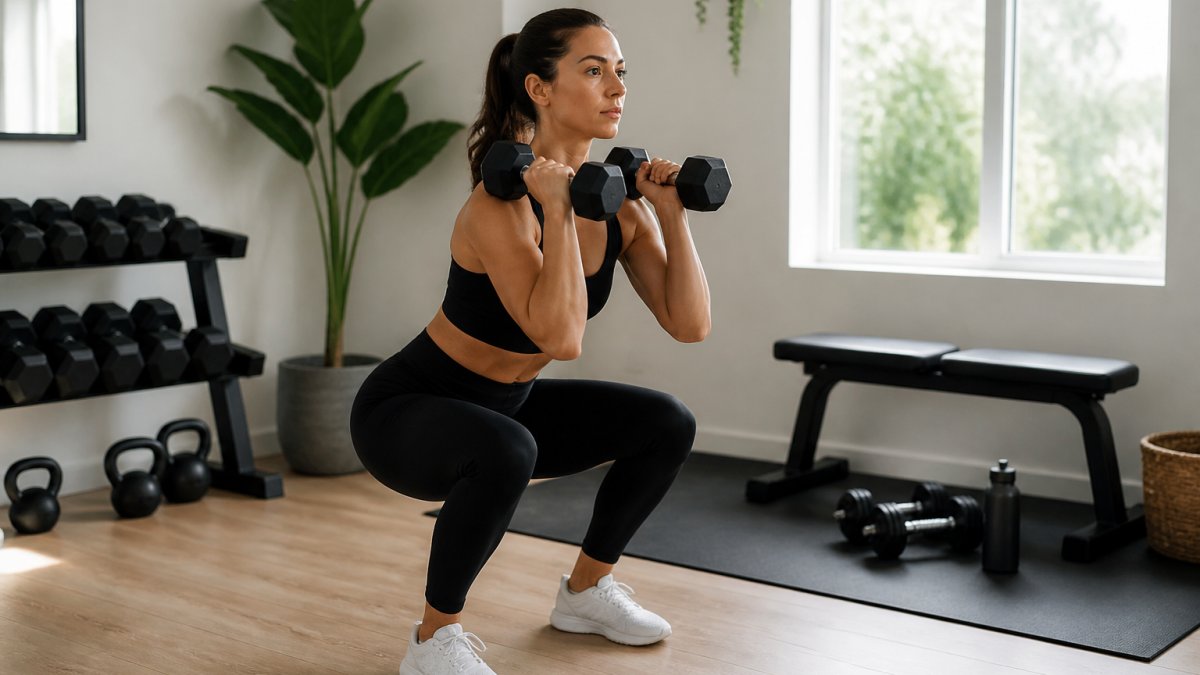
A Practical 20-Minute Full-Body Routine
Here is a complete, timed session you can run today. It uses four compound movements and fits inside 20 minutes including a short warm-up. Rest periods are built in.
Warm-up (0:00-2:30)
- 60 seconds of marching in place or jumping jacks
- 60 seconds of bodyweight squats
- 30 seconds of arm circles and shoulder rolls
Block 1, Goblet Squat or Dumbbell Squat (2:30-7:00)
- 3 sets of 8-12 reps
- Rest 60 seconds between sets
- Targets quads, glutes, and core
Block 2, Dumbbell Bench Press or Push-Up (7:00-11:00)
- 3 sets of 8-12 reps
- Rest 60 seconds between sets
- Targets chest, shoulders, and triceps
Block 3, One-Arm Dumbbell Row or Band Row (11:00-15:00)
- 3 sets of 8-12 reps per side
- Rest 45-60 seconds between sets
- Targets back and biceps
Block 4, Romanian Deadlift or Hip Hinge (15:00-18:30)
- 2-3 sets of 8-12 reps
- Rest 45-60 seconds between sets
- Targets hamstrings, glutes, and lower back
Cool-down (18:30-20:00)
- 60 seconds of slow walking
- 30-60 seconds of light stretching for the muscles you trained
If you only have two dumbbells or a single band, this routine still works. Swap the goblet squat for a band squat, the bench press for a band chest press, and the row for a band row. The movement patterns stay the same.
How to Progress Without Adding Time
Progression in a 20-minute session comes from four levers, none of which require a longer workout:
- Load, Add 2.5-5 pounds to a movement once you hit the top of the rep range with clean form.
- Repetitions, Add one rep per set before adding weight.
- Range of motion, Deepen a squat or slow the lowering phase to increase time under tension.
- Rest reduction, Cut 10-15 seconds off rest periods every two weeks.
Pick one lever at a time and hold the others steady for two to three weeks. This is the simplest way to apply progressive overload when time is fixed.
Sets, Repetitions, and Rest Periods
For a 20-minute session, keep rest periods tight. You won't have the luxury of long breaks between sets. This actually increases the training stimulus and saves time.
Recommended structure for short sessions:
- Sets: 3-4 per exercise
- Repetitions: 6-12 per set (heavier weight, fewer reps)
- Rest between sets: 60-90 seconds
- Rest between exercises: 90-120 seconds
Shorter rest periods force your cardiovascular system to work harder. This creates a training stimulus similar to higher-rep training, even though you're lifting heavier weight. It's a time-efficient way to build both strength and muscle.
Progressive Overload for Beginners: Growing Stronger Over Time
Progressive overload is how you force your muscles to adapt and grow. It means gradually increasing the challenge over weeks and months. Without it, your body adapts to the same weight and stops making progress.
For beginners starting with 20-minute sessions, progressive overload might look like:
Week 1-2: Learn the movement pattern with moderate weight Week 3-4: Add 5-10 pounds to each exercise Week 5-6: Add another 5-10 pounds or add one extra rep per set Week 7-8: Reduce rest periods by 15 seconds between sets
The progression doesn't have to be dramatic. Small, consistent increases compound into significant strength gains over months. A beginner who adds 5 pounds per week to their main lifts will be 20-30% stronger in 6 months.
Weekly Training Volume and Recovery
Weekly training volume, the total number of hard sets across all workouts, is the strongest driver of muscle growth and strength. A 20-minute session done three times per week typically produces 9-12 total sets per muscle group per week. Whether that is enough depends on your goal.
What 'Enough' Means for Different Goals
| Goal | Weekly Sets Per Muscle Group | 20-Minute Sessions Needed | Notes |
|---|---|---|---|
| General health and maintenance | 4-6 | 2-3 per week | Enough to preserve muscle and support metabolic health |
| Beginner strength and muscle | 6-10 | 3 per week | Steady progress with progressive overload |
| Intermediate muscle growth | 10-15 | 4 per week | Requires consistent overload and adequate protein |
| Advanced strength or size | 15-20+ | 4-5 per week | 20 minutes becomes limiting; longer sessions help |
For general health, two to three 20-minute sessions per week is enough. For building noticeable muscle, most people need at least three sessions and a clear progression plan. For advanced goals, 20 minutes per day can maintain progress but rarely maximizes it.
How 20 Minutes Translates to Weekly Volume
A single 20-minute full-body session with four compound movements and three sets each produces roughly 12 working sets total. Spread across the major muscle groups, that is about 3-4 sets per muscle group per session. Multiply by three sessions per week and you land at 9-12 sets per muscle group weekly, squarely in the beginner-to-intermediate range.
If you train the same muscles on consecutive days, you cut into recovery without adding useful volume. A better pattern is to leave at least 48 hours between sessions that hit the same muscle groups hard. Full-body training on Monday, Wednesday, and Friday is the simplest way to hit that spacing.
Recovery Checklist
Recovery is the often-forgotten variable. Your muscles don't grow during the workout, they grow during rest. Sleep, nutrition, and stress management matter as much as the actual training.
A practical recovery checklist:
- Sleep 7-9 hours nightly (the CDC)
- Eat adequate protein (0.7-1 gram per pound of body weight)
- Take at least one full rest day per week
- Manage stress through walking, stretching, or meditation
- Watch for signs of under-recovery: persistent soreness, stalled lifts, poor sleep, or low motivation
Common Mistakes With Short Workouts
Short workouts fail for predictable reasons. Understanding these mistakes helps you avoid them and get real results in 20 minutes.
Mistake 1: Too many exercises. Trying to fit 6-8 exercises into 20 minutes spreads your effort too thin. You'll do each exercise with less weight and fewer sets.
Mistake 2: Too light weight. Many people underestimate how heavy they should go in a short session.
Mistake 3: Inconsistent frequency. One 20-minute session per week won't build muscle or strength. You need at least 3 sessions weekly to accumulate enough volume.
Mistake 4: No progression plan. Doing the same weight and reps every week guarantees zero progress. Your body adapts quickly.
Mistake 5: Poor exercise selection. Wasting time on isolation exercises (bicep curls, leg extensions) in a short session is inefficient.
Conclusion
20 minutes of resistance training daily is enough if you're consistent, focused, and progressive. The results depend entirely on your goals, training frequency, and how hard you work during those 20 minutes.
For beginners building a foundation or people maintaining muscle with limited time, daily 20-minute sessions work. For building significant muscle or strength, you'll see faster progress training 3-4 days per week with higher intensity than daily lighter sessions.
Health and Fitness Company supports your training goals with precision-engineered equipment like our Fitness Exercises Resistance Bands Set ($58.59), which provides up to 360 pounds of resistance for full-body workouts in minimal space. Our FIXTECH Adjustable Dumbbell Set ($227.74) lets you scale weight instantly, making progressive overload simple and efficient.


Frequently Asked Questions
Can 20 minutes of resistance training build muscle?
Yes, 20 minutes of resistance training can build muscle if you focus on compound exercises, maintain proper intensity, and allow adequate recovery. The key is training multiple muscle groups with sufficient effort and consistency. A 20-minute session performed 3-4 times per week totals 60-80 minutes weekly, which meets evidence-based guidelines for strength gains. Progressive overload, gradually increasing weight or reps, is essential to continued muscle growth.
How many days a week should I do resistance training?
Most evidence suggests 3-4 days per week of resistance training is optimal for muscle growth and strength gains. If you're doing 20-minute sessions, aim for at least 3 days weekly to accumulate sufficient weekly volume. Allow at least one rest day between sessions targeting the same muscle groups to permit recovery. Beginners can start with 2-3 days per week and progress as strength and conditioning improve.
What's the difference between resistance training and weight training?
Resistance training is any exercise that works muscles against opposing force, including dumbbells, barbells, resistance bands, and bodyweight exercises. Weight training specifically uses free weights like dumbbells and barbells. Resistance bands, like our Fitness Resistance Band or Strength Resistance Band, provide effective resistance training without requiring heavy equipment, making them ideal for 20-minute home workouts. Both approaches build muscle and strength when performed with proper intensity and consistency.
Should I do resistance training every day?
No. Doing resistance training every day increases injury risk and prevents adequate muscle recovery. Rest days allow muscle repair and adaptation, which is when growth actually occurs. Training the same muscle groups on consecutive days limits strength gains and can lead to overuse injuries. A schedule of 3-4 resistance-training days per week with at least one rest day between sessions is more effective than daily training for most goals.