Strength Training Equipment Set: 5 Picks for Home Gyms

Table of Contents
- How to Choose a Strength Training Equipment Set
- FIXTECH Adjustable Dumbbell Set: The 4-in-1 Space Saver
- JOOYHOOM 2-in-1 Dumbbell and Barbell Set: The Budget Barbell Option
- GIKPAL 160 lb Adjustable Dumbbells: For Serious Progressive Overload
- Everyday Essentials Kettlebell Set: Adding Versatility to Your Routine
- Why Adjustable Dumbbells for Home Gym Are the Smart Core Choice
- Building a Home Gym Workout Routine for Beginners
- The Benefits of Weighted Wrist and Ankle Bands for Training
- Frequently Asked Questions
Last Updated: September 8, 2026
Building a complete home gym often stalls at one question: which strength training equipment set actually delivers results without taking over your living space? A dedicated strength training equipment set is the foundation of consistent resistance training, but the market is flooded with options ranging from flimsy plastic weights to massive commercial racks. This guide from Health and Fitness Company focuses on adjustable systems that maximize versatility while respecting square footage and budget.
How to Choose a Strength Training Equipment Set
The best strength training equipment set for your home gym depends on three variables: your current strength level, the space you can dedicate to training, and the exercises you actually enjoy performing. A common mistake is buying a fixed-weight set you will outgrow within months; adjustable options consolidate multiple weight configurations into a single, space-efficient unit.
Before you commit, consider your training style. If you prefer compound movements like squats and deadlifts, you need a set that can function as a barbell or load up to a significant weight. If your routine leans on isolation exercises like curls and lateral raises, a pair of quality adjustable dumbbells is sufficient. Durability matters equally: look for steel cores, anti-slip grips, and secure locking collars.

FIXTECH Adjustable Dumbbell Set: The 4-in-1 Space Saver
For most home gyms, the FIXTECH Adjustable Dumbbell Set is the most practical starting point because it replaces four separate pieces of equipment with one compact system. This strength training equipment set converts from a pair of dumbbells into a barbell, kettlebells, and push-up stands, covering the majority of exercises in a typical strength training program.

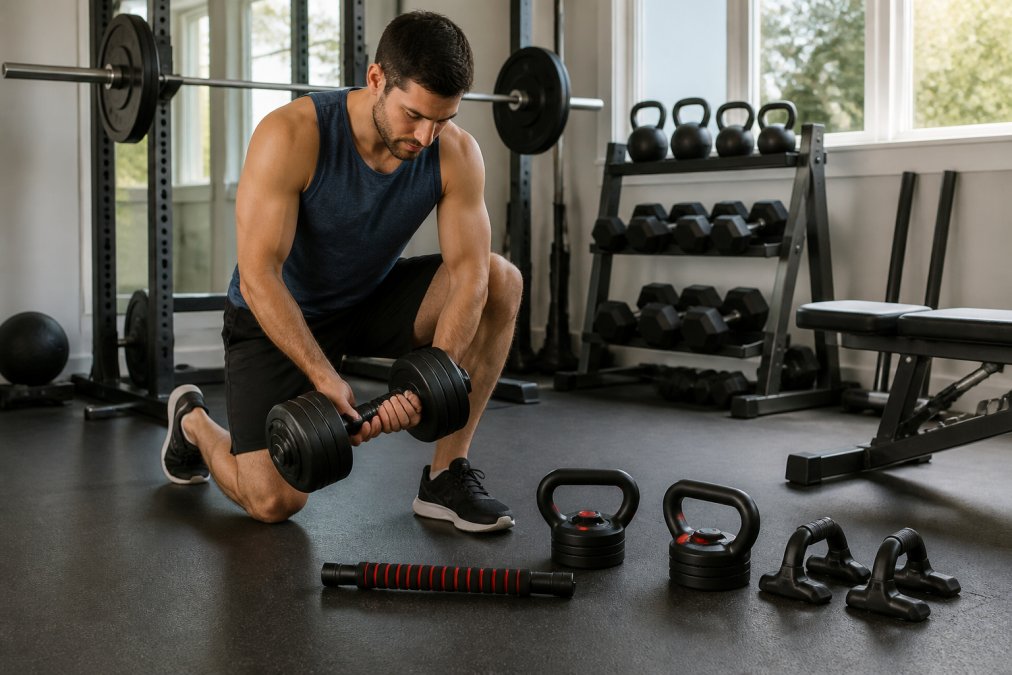
The set comes in 20, 30, 50, and 70 lb configurations, allowing you to scale up as you get stronger. At $227.74, it delivers significant value compared to buying separate dumbbells, a barbell, and kettlebells (consumerreports.org).
JOOYHOOM 2-in-1 Dumbbell and Barbell Set: The Budget Barbell Option
If your priority is affordability and you are just starting your strength training journey, the JOOYHOOM 2-in-1 set offers a solid foundation at $165.01. This strength training equipment set pairs two dumbbells with a connecting steel rod, letting you switch from pressing movements to barbell-style lifting in seconds. The embossed metal weight plates feature clear markings.

The trade-off is lower maximum weight capacity. The set tops out at 66 lb, which suits beginners and those focused on higher-rep endurance training but will limit heavy lifters pursuing maximal strength gains (acefitness.org). The anti-slip neoprene grips and curved handlebar design are features of the product.
GIKPAL 160 lb Adjustable Dumbbells: For Serious Progressive Overload
For lifters who have hit a plateau with lighter sets, the GIKPAL 160 lb adjustable dumbbells are the clear upgrade path. This strength training equipment set includes two dumbbells, each adjustable from 5 to 80 lb across 16 levels, which is enough weight to challenge even advanced athletes on major compound lifts. The rotating dial lets you change resistance in about one second.
At $495.14, this is the most expensive option here, but the price reflects its capacity to serve as your only dumbbell purchase for years. The carbon steel core and safety lock mechanism are features of the product, and the compact footprint replaces an entire rack of individual dumbbells. Fine weight increments allow you to add resistance in small, manageable steps.
Everyday Essentials Kettlebell Set: Adding Versatility to Your Routine
Strength training is not limited to dumbbells and barbells. Kettlebells introduce a dynamic element that builds power, cardiovascular endurance, and grip strength through ballistic movements like swings and cleans. The Pro 3-Piece Kettlebell Set from Everyday Essentials includes 5, 10, and 15 lb kettlebells with a base rack for organized storage, all for $99.99, a low-cost way to add variety to a routine built around a primary strength training equipment set.
The kettlebells are constructed from durable PE and filled with cement. The wide, textured grips are comfortable for two-handed swings and allow for smooth transitions during complex movements.
Why Adjustable Dumbbells for Home Gym Are the Smart Core Choice
The central decision in any home gym build is whether to buy fixed dumbbells or an adjustable pair. Adjustable dumbbells for home gym use are the smarter choice for most people because they deliver the functionality of an entire rack in the footprint of a single pair. This is the core of a smart strength training equipment set strategy: invest in one system that scales with your ability rather than filling a room with redundant iron.
Fixed dumbbells have their place, particularly in commercial gyms where multiple users train simultaneously. At home, however, they represent poor use of both money and space. A full set from 5 to 50 lb can demand a dedicated storage rack, while an adjustable pair achieves the same range and fits in a closet corner.
Building a Home Gym Workout Routine for Beginners
Once your strength training equipment set arrives, the next step is structuring a routine that builds a foundation safely. For beginners, a full-body workout performed three times per week is a common starting protocol, as it trains every major muscle group with adequate recovery time between sessions (the CDC). Focus on compound movements that engage multiple joints and muscles simultaneously.
A simple beginner session might include goblet squats, dumbbell bench presses, bent-over rows, and kettlebell swings. Perform three sets of eight to twelve repetitions for each exercise, resting about ninety seconds between sets. Start with a weight that allows you to complete all repetitions with good form, then increase the load by the smallest increment available when you can comfortably finish the top of the rep range. This methodical approach, known as progressive overload, is a reliable path to building muscle and strength.
Optimizing Your Routine for Small Spaces
Most home gym guides assume you have a garage or a spare room. The reality for many lifters is that the training area is a corner of a bedroom or a section of a living room. Here is how to maximize a compact footprint:
- Design a 'Station-Free' Workout: Instead of moving between a bench, a rack, and a floor mat, sequence your exercises to minimize equipment changes. Perform all your seated movements (overhead press, bench press) first, then transition to standing movements (rows, squats), and finish with floor work (kettlebell swings, core exercises). This reduces the time you spend rearranging your space.
- Use a Single 'Home Base' Mat: A 4x6 ft rubber mat defines your entire training zone. If you are using a bench, place it on the mat. When you move to floor exercises, the bench moves out of the way. This visual boundary also protects your flooring from dropped weights.
- Time-Block Your Setup and Teardown: A common reason beginners abandon home workouts is the perceived hassle of setup. Allocate a specific 5-minute window before and after your session for equipment setup and storage. Treat this as part of the workout. Over time, this becomes a ritual that reinforces consistency.
Budget-to-Performance Ratio: Where to Spend First
When building a home gym on a budget, the order of purchases matters more than the total amount spent. To maximize your budget-to-performance ratio, follow this priority sequence:
- The Adjustable Dumbbell Set (Your Primary Investment): This is where the majority of your budget should go. It is the core of your strength training equipment set. A set with a wide weight range (e.g., 5-50 lb per hand) can serve you for years.
- A Flat or Adjustable Bench: This unlocks pressing and rowing variations that are impossible on the floor. A sturdy bench is important. Look for one with an appropriate weight capacity.
- A Single Kettlebell: One kettlebell adds a dynamic conditioning element without the cost of a full set.
- Resistance Bands: These are cheap and versatile, but they are not a substitute for free weights. Use them for warm-ups, mobility work, and accessory movements.
| Training Phase | Frequency | Reps per Set | Rest Between Sets | Primary Goal |
|---|---|---|---|---|
| Beginner (Months 1-2) | 3 days/week | 10-12 | 90 seconds | Form and endurance |
| Intermediate (Months 3-6) | 4 days/week | 8-10 | 60-90 seconds | Muscle growth |
| Advanced (6+ months) | 4-5 days/week | 5-8 | 2-3 minutes | Maximal strength |
The Benefits of Weighted Wrist and Ankle Bands for Training
While a primary strength training equipment set forms the core of your home gym, weighted wrist and ankle bands serve a distinct purpose: they add incremental resistance to bodyweight and cardio movements without the joint loading of heavy free weights. This makes them suitable for conditioning and core stability work, but their effectiveness and safety depend entirely on proper use and maintenance.
Selecting the Right Resistance
Unlike dumbbells, where weight is the primary variable, the key metric for bands is the distribution of that weight. A general guideline is to start with 1 to 2 lb per wrist and 2 to 3 lb per ankle.
Maintenance and Longevity: The Missing Guide
The most common failure point for weighted bands is not the weight itself, but the stitching and the closure system. Here is a practical maintenance protocol to extend the life of your investment:
- Inspect the Seams: Before each use, run your fingers along the stitching, especially where the weight pouches are sewn in. Look for loose threads or fraying.
- Clean the Fabric: Sweat and body oils degrade elastic and fabric over time. After each workout, wipe the bands down with a damp cloth and a mild detergent. Do not submerge them in water.
- Check the Fasteners: Hook-and-loop closures (Velcro) lose their grip as lint and dust accumulate. Use a stiff brush to clean the loops periodically. If the closure begins to slip during a set, replace the bands immediately.
- Store Flat, Not Folded: Folding bands can crease the fabric and stress the stitching. Store them flat in a drawer or hang them by the closure strap. This simple habit prevents premature wear.
Safety Protocols for Solo Lifters
When you train alone at home, there is no spotter to catch a failing rep or a falling weight. To mitigate this:
- Always Train on a Non-Slip Surface: Use a yoga mat or rubber flooring to provide traction and to protect the bands from abrasive concrete or hardwood.
- Secure the Closure Over the Tightest Part of the Limb: Do not fasten the band loosely around the joint. Position it higher on the forearm or calf where the muscle belly is largest, and cinch the strap firmly.
- Avoid Sudden, Explosive Movements When First Starting: Give your stabilizer muscles time to adapt to the added distal weight. Start with controlled tempos (2 seconds up, 2 seconds down) before progressing to faster, plyometric-style movements.
By following these maintenance and safety protocols, you ensure that your weighted bands remain a reliable, long-lasting supplement to your main strength training equipment set.
Frequently Asked Questions
What is the best strength training equipment set for a small apartment?
For small spaces, adjustable dumbbells are the most practical choice. A set like the FIXTECH 4-in-1 replaces a rack of traditional dumbbells, a barbell, and kettlebells. Look for sets that include a storage tray or base, like the GIKPAL model, to keep your floor clear. This approach gives you a full-body workout without dedicating a whole room to bulky machinery.
Are adjustable weights better than fixed weight sets?
Adjustable weights are better for most home gyms because they save significant space and money. A single adjustable dumbbell set can replace 5 to 16 individual pairs of fixed dumbbells. The trade-off is speed: changing weight on a traditional set takes a few seconds, while some adjustable dials take just one second. If you train alone at home, the space savings almost always outweigh the convenience of fixed sets.
How much space do you need for a home strength training equipment set?
You need roughly a 6 by 6 foot area for a basic setup with adjustable dumbbells and a bench. This gives you room to safely perform presses, rows, and curls. If you want to use a barbell for deadlifts or squats, you will need a larger area, at least 8 by 8 feet. For most beginners, a compact adjustable dumbbell set is the most space-efficient way to start strength training.
What is the best way to combine weighted wrist and ankle bands with dumbbells?
Use weighted wrist and ankle bands for bodyweight exercises and cardio, not for heavy compound lifts. For example, wear them during walking lunges, leg raises, or shadow boxing to increase training intensity without loading your spine. Save your dumbbells for exercises that require a firm grip, like curls and presses. This combination adds variety and keeps your joints safe from unnecessary strain.