Weighted Bands vs Dumbbells for Muscle Growth

Table of Contents
- Weighted Bands vs Dumbbells: Quick Comparison
- How Weighted Bands and Dumbbells Create Muscle Growth
- Benefits of Weighted Wrist and Ankle Bands
- Pros and Cons of Resistance Bands
- Pros and Cons of Dumbbells
- Progressive Overload with Resistance Bands
- Hybrid Training: Combining Both Tools
- Which Should You Choose?
Last Updated: August 29, 2026
Weighted Bands vs Dumbbells: Quick Comparison
When it comes to building muscle, the choice between weighted bands vs dumbbells for muscle growth shapes everything about your training outcomes. At Health and Fitness Company, we understand how both tools drive different physiological adaptations, and the answer isn't "pick one." The real insight is understanding when each excels and how combining them creates superior results.
Both tools build muscle. Dumbbells provide gravity-based resistance that feels intuitive and measurable. Resistance bands create variable resistance that changes throughout the movement. One isn't inherently better, they stress your muscles differently, which is exactly why the most advanced athletes use both.

Here's what separates a mediocre training program from one that maximizes hypertrophy: knowing how to layer these tools strategically. The athletes seeing the fastest muscle gains aren't choosing between them. They're using each where it works best.
| Factor | Weighted Bands | Dumbbells | Winner |
|---|---|---|---|
| Progressive Overload | Incremental resistance increase | Precise weight jumps | Dumbbells |
| Variable Resistance Profile | Increasing tension | Constant tension | Bands |
| Range of Motion | Full-range constant tension | Peak contraction strength | Dumbbells |
| Portability | Highly portable | Heavy/space-intensive | Bands |
| Joint Stress | Lower impact | Higher joint load | Bands |
| Muscle Fiber Recruitment | Peak contraction emphasis | Full-range recruitment | Dumbbells |
| Cost | $15-40 per band | $165+ for sets | Bands |
How Weighted Bands and Dumbbells Create Muscle Growth
Muscle growth happens through three primary mechanisms: mechanical tension, metabolic stress, and muscle damage (peer-reviewed research). Dumbbells and resistance bands trigger these differently, which is why understanding the distinction matters for your programming.
Mechanical Tension and Muscle Activation
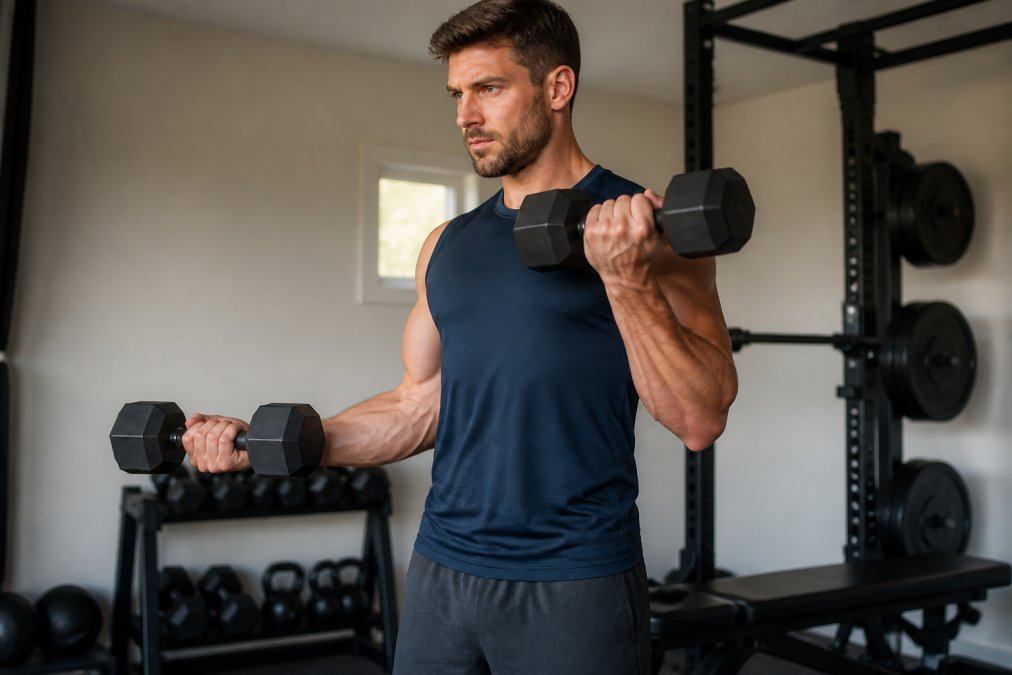
Mechanical tension is the primary driver of hypertrophy, the force your muscles generate against resistance. Dumbbells excel here because they provide constant tension throughout the movement. When you press a 40-pound dumbbell overhead, you're fighting gravity consistently from start to finish. Your stabilizer muscles activate maximally to control the weight through the entire range of motion.
Resistance bands create something different: variable resistance. The band's tension increases as it stretches, meaning the hardest part of the movement happens at peak contraction. This is valuable, but it's not constant tension. Early in the movement, when the band is slack, your muscles work less. At full extension, the tension spikes dramatically.
For compound movements like squats and presses, dumbbells' constant tension creates superior neuromuscular adaptation. Your nervous system must recruit muscle fibers consistently throughout the entire range. With bands, the recruitment pattern changes mid-movement, which can reduce time under tension in the easier portions.
Progressive Overload Approaches
Progressive overload, systematically increasing training demands, is non-negotiable for muscle growth. How you apply it differs between tools, and this difference has real consequences for long-term gains.
With dumbbells, progressive overload is straightforward: add weight. Jump from 30 pounds to 35 pounds. Your muscles immediately face greater mechanical tension. The progression is linear and measurable. This precision is why dumbbells are the gold standard for strength athletes tracking incremental improvements.
Resistance bands require a different approach. You can't simply "add 5 pounds" to a band. Instead, you progress by using a heavier band, performing more reps, slowing the tempo, or reducing rest periods. You can also double up bands, combining two bands creates exponentially more resistance than one. The progression is less precise, which makes tracking harder but also creates novelty that can prevent adaptation plateaus.
The practical implication: if you're serious about tracking progress and hitting specific strength targets, dumbbells give you clearer feedback. If you're optimizing for metabolic stress and constant tension variation, bands offer advantages dumbbells can't match.
Benefits of Weighted Wrist and Ankle Bands
Weighted wrist and ankle bands solve a specific problem: adding resistance to bodyweight movements without the bulk of dumbbells. When you strap a weighted band around your wrist during pull-ups or around your ankle during leg raises, you're adding load to movements that dumbbells can't easily accommodate.
These bands excel for isolation work. A 5-pound weighted ankle band during lying leg raises creates intense metabolic stress on the quads and hip flexors. Try doing the same movement holding a 5-pound dumbbell, it's awkward and limits your range of motion. The band stays in place, maintaining constant tension throughout the full range.
Wrist bands work similarly for pull-ups, chin-ups, and hanging movements. The weight hangs naturally, and your grip doesn't need to accommodate the implement. This is where bands outperform dumbbells for pure hypertrophy in upper body pulling movements.
Health and Fitness Company offers quality resistance bands, such as the Strength Resistance Band at $15.64, which are accessible for athletes building comprehensive home gyms.
Pros and Cons of Resistance Bands
Pros:
- Variable resistance increases tension at peak contraction, maximizing the strongest portion of movements
- Extremely portable, roll them into a gym bag or suitcase for training anywhere
- Lower joint stress compared to heavy dumbbells, making them ideal for rehabilitation and prehabilitation (peer-reviewed research)
- Constant tension throughout the entire range of motion creates metabolic stress efficiently
- Affordable entry point to resistance training, quality bands cost less than a single dumbbell set
- Reduced impact on floors and surrounding equipment, important for apartment dwellers and shared spaces
- Eccentric phase control feels smoother, reducing injury risk during the lowering portion of movements
Cons:

- Progressive overload requires band replacement or stacking multiple bands, making progression less precise
- Inconsistent resistance profile, lighter in the early range of motion means reduced time under tension initially
- Durability concerns with cheaper bands; low-quality materials snap or lose elasticity within months
- Limited for heavy compound movements requiring maximum mechanical tension
- Harder to quantify progress, you can't simply say "I lifted 50 pounds" with the same clarity as dumbbells
- Requires anchoring points for many exercises, limiting exercise selection in certain environments
- Muscle fiber recruitment patterns differ from free weights, potentially missing some adaptation benefits
Pros and Cons of Dumbbells
Pros:
- Constant tension throughout the movement maximizes mechanical tension and neuromuscular recruitment
- Precise progressive overload, jump from 30 to 35 pounds with measurable strength gains
- Superior for compound movements like presses, rows, and squats where stabilization demands are high
- Clear progress tracking allows for periodized programming and strategic deload weeks
- Full range of motion control, you decide the tempo and range, not the resistance curve
- Durable and reliable, quality dumbbells last decades with minimal maintenance
- Functional carry-over to real-world strength demands requiring stabilization and control
- Excellent for isolation exercises where constant tension drives hypertrophy
Cons:
- Heavy and space-intensive, a complete dumbbell set requires significant storage
- Expensive upfront investment; quality adjustable sets start at $165 for basic ranges
- Higher joint stress compared to bands, particularly for beginners or those with existing injuries
- Difficult to transport, limiting training flexibility for frequent travelers
- Can damage floors and equipment if dropped or mishandled
- Limited variable resistance, the resistance curve stays constant regardless of joint angle
- Requires more stabilization, which can be overwhelming for beginners still learning movement patterns
- Eccentric control demands higher neuromuscular fatigue, increasing injury risk if form breaks down
Progressive Overload with Resistance Bands
Progressive overload with bands requires a different mindset than dumbbells. You're not simply adding weight, you're manipulating multiple variables to increase training demands.
Resistance Progression: Move to a heavier band. Most quality band sets come in multiple resistance levels. Progressing from a light band to medium band represents a significant jump in resistance, typically equivalent to 10-15 pounds of added tension at peak contraction (peer-reviewed research).
Volume Progression: Add reps or sets. If you completed 3 sets of 12 reps with a band, aim for 3 sets of 15 reps next week. Once you hit 15 reps consistently, increase to 4 sets. This approach works exceptionally well for metabolic stress and hypertrophy.
Tempo Manipulation: Slow down the movement. A 3-second concentric phase, 1-second pause, and 3-second eccentric phase dramatically increases time under tension. This drives hypertrophy even without adding external load.
Band Stacking: Use two bands simultaneously. Doubling bands doesn't simply double resistance, it increases exponentially because both bands are stretching. This creates a significant jump in difficulty without purchasing new equipment.
Mechanical Variation: Change use or body position. Performing banded chest presses from a half-kneeling position instead of standing increases stabilization demands, recruiting more muscle fibers despite identical external resistance.
The key: bands reward volume and intensity variation more than dumbbells reward simple weight increases. Your progress tracking looks different, focus on reps, sets, and how the movement feels rather than absolute load numbers.
Hybrid Training: Combining Both Tools
The athletes achieving the fastest muscle growth aren't choosing between weighted bands vs dumbbells for muscle growth, they're using both strategically within the same workout.
Here's the framework: use dumbbells for heavy compound movements where you need maximum mechanical tension and precise progressive overload. Use bands for isolation work, higher-rep ranges, and movements where variable resistance creates superior metabolic stress.
A practical example: Chest day with both tools. Start with dumbbell bench press for 4 sets of 6-8 reps, focusing on heavy mechanical tension. Follow with banded chest flyes for 3 sets of 12-15 reps, where the variable resistance creates peak contraction emphasis. Finish with banded push-ups for 3 sets to failure, using the band's variable tension to drive metabolic stress during the easier early range of motion.

This combination addresses all three hypertrophy mechanisms: heavy dumbbells drive mechanical tension, band isolation work creates metabolic stress, and the volume from both creates sufficient muscle damage. Your stabilizer muscles get trained through dumbbell complexity, while your prime movers get isolated tension through bands.
The practical advantage: you're not limited by a single tool's constraints. Dumbbells alone miss the variable resistance benefits of bands. Bands alone miss the heavy mechanical tension that drives maximum strength and muscle fiber recruitment. Together, they're synergistic.
Health and Fitness Company offers both adjustable dumbbells and resistance bands, letting you build a complete hybrid training setup. The Adjustable Dumbbell Barbell Weight Pair at $165.01 provides the heavy mechanical tension foundation, while the Strength Resistance Band at $15.64 handles variable resistance work. This combination covers both resistance profiles without breaking your budget.

Which Should You Choose?
The answer depends on your specific situation, not on which tool is objectively "better."
Choose dumbbells if:
- You're focused on maximum strength and muscle size simultaneously
- You have space for equipment storage
- You want precise, measurable progress tracking
- You're training compound movements as your primary focus
- You can invest in quality equipment upfront
- You're training in a stable environment (home gym, commercial gym) where portability isn't essential
Choose resistance bands if:
- You travel frequently or need portable training equipment
- You have joint issues or are recovering from injury
- You're focused on metabolic stress and higher-rep hypertrophy
- You have limited space
- You're just starting and want affordable entry into resistance training
- You need variable resistance for specific isolation movements
- You want to reduce impact on floors and surrounding equipment
The honest answer: if you're serious about muscle growth and have the resources, get both. The investment in a quality dumbbell set ($165-230) plus bands ($15-40) creates a training system that addresses every hypertrophy mechanism. You're not making a trade-off, you're building redundancy and flexibility into your program.
For most people starting out, dumbbells provide better foundational strength and muscle gains. The mechanical tension and progressive overload clarity make them superior for compound movements. Add bands once you've built a base and understand how variable resistance fits your training style.
The athletes seeing the fastest results aren't debating which tool is better. They're using each tool where it excels, progressing intelligently with both, and staying consistent long enough to see results. That's the real difference between mediocre and exceptional muscle growth.
Frequently Asked Questions
Q: Do resistance bands build muscle as effectively as dumbbells?
A: Both tools build muscle, but through different mechanisms. Dumbbells create constant tension throughout the movement and excel at heavy compound exercises. Resistance bands provide increasing tension as you extend them, which maximizes peak contraction and metabolic stress. Research shows bands can produce similar hypertrophy when training volume and intensity are matched. The best choice depends on your exercises and training style.
Q: What are the benefits of weighted wrist and ankle bands for training?
A: Weighted wrist and ankle bands add resistance to bodyweight and cardio exercises without requiring equipment changes. They increase muscle activation during functional movements, enhance stability work, and allow progressive overload on exercises like pull-ups, leg raises, and running. They're portable, affordable, and effective for isolation training and rehabilitation. They're ideal for athletes who need variable resistance without the bulk of dumbbells.
Q: How do you track progressive overload with weighted bands versus dumbbells?
A: With dumbbells, progressive overload is straightforward: increase the weight in 5-10 lb increments. With resistance bands, track progress by using thicker/stronger bands, increasing reps, slowing down the eccentric phase, or reducing rest periods. You can also layer multiple bands for greater resistance. Dumbbells offer more precise load measurement, while bands require attention to tension and time under tension to ensure continued muscle growth.
Q: Are weighted bands better for joint health than dumbbells?
A: Resistance bands may be gentler on joints because they provide variable resistance that's lighter at the start of a movement. This reduces stress on vulnerable joint positions. Dumbbells maintain constant tension throughout, which can stress joints at weaker angles. However, both are safe when used with proper form. Bands work well for rehabilitation and joint-friendly training, while dumbbells support heavier strength work. The best choice depends on your current joint health and training goals.
Building muscle requires tools that match your training philosophy and goals. Health and Fitness Company's adjustable weighted equipment, from precision dumbbells to variable resistance bands, gives you the flexibility to implement both approaches. Whether you start with dumbbells for foundational strength or bands for accessible training, our products are engineered for durability and performance. Get started with equipment designed to support your full potential.
This article was written using GrandRanker