Durability of Alloy vs Steel Handlebars: 2026 Guide

Table of Contents
- Material Properties: Steel vs Aluminum
- Weight, Vibration Dampening, and Ride Quality
- Aluminum Handlebar Fatigue Life: What the Data Shows
- Best Alloy Handlebars for Mountain Bikes
- How to Inspect Bike Handlebars for Cracks
- Cost, Maintenance, and Environmental Impact
- Conclusion
- Frequently Asked Questions
Last Updated: September 10, 2026
Material Properties: Steel vs Aluminum
The durability of alloy vs steel handlebars comes down to one trade-off: steel resists fatigue cracking far longer, while aluminum alloy is significantly lighter. Chromoly steel offers the highest tensile strength and fatigue life of the two, but it carries a weight penalty that most riders feel on every climb.
At Health and Fitness Company, we field this question constantly from riders weighing an upgrade. Here is the short version: aluminum alloy handlebars dominate the market because they are light and stiff, but steel remains the choice when maximum fatigue life matters more than grams.
The alloy vs steel handlebars debate starts with material properties:
| Property | Chromoly Steel | Aluminum Alloy |
|---|---|---|
| Weight | Heavier | Lighter |
| Fatigue life | Very high (endurance limit) | Finite (no endurance limit) |
| Stiffness | High | High, but can be tuned |
| Corrosion resistance | Needs coating | Naturally oxidation-resistant |
| Cost | Lower | Moderate |
Steel has an endurance limit, meaning it can survive an effectively unlimited number of stress cycles below a certain load. Aluminum has no such limit. Every stress cycle, however small, contributes to micro-fractures. That single fact explains most of the durability gap.
ASM International materials reference on metal fatigue
Weight, Vibration Dampening, and Ride Quality
Steel handlebars absorb vibration better than aluminum, which translates to less hand fatigue on long rides. Aluminum transmits more road buzz because it is stiffer and has lower internal damping. That stiffness cuts both ways: it improves steering precision but reduces compliance.
Weight matters just as much. A steel bar can add a noticeable weight penalty at the front end, which changes how the bike handles on technical descents. Alloy keeps the front end light and quick.
- Vibration dampening: Steel wins, especially on rough gravel and chunky trails.
- Ride quality: Alloy feels sharper; steel feels calmer.
- Weight penalty: Alloy wins by a clear margin.
- Stiffness-to-weight ratio: Alloy leads.
For riders logging long distances, vibration absorption is not a luxury. It is the difference between finishing a ride fresh and finishing it with numb hands.
Aluminum Handlebar Fatigue Life: What the Data Shows
Aluminum handlebar fatigue life is finite, and the mechanism is well understood. Because aluminum lacks an endurance limit, every stress cycle, no matter how small, accumulates microscopic damage. Cracks typically initiate at stress concentrators: the stem clamp edges, the brake and shifter perch zones, and any scratch or gouge that interrupts the surface. Once a crack initiates, it propagates a little further with each load cycle until the remaining cross-section can no longer carry the load.
Steel behaves differently. Below its endurance limit, chromoly can endure millions of stress cycles without crack initiation. That is why steel touring frames and bars often outlast several aluminum replacements. The endurance limit is not infinite strength, it is a threshold below which cyclic damage does not accumulate.
What the standards actually test. The relevant framework comes from ISO 4210, the international safety standard for bicycles, which specifies dynamic fatigue tests for handlebars and stems. In a typical ISO 4210 handlebar fatigue test, the bar is clamped at the stem and loaded at the grip ends with a cyclic force, commonly in the range of several hundred newtons, for on the order of 100,000 cycles, depending on the bar category (city/trekking, mountain, or racing). Bars that pass have demonstrated a minimum fatigue life under a defined load; they have not demonstrated infinite life. That distinction is the whole point.
A common pattern in failure analysis is that aluminum bars do not fail from a single overload. They fail from the cumulative effect of thousands of small loads, road buzz, braking forces, and the rider's weight shifting, concentrated at the clamp. This is why a bar that feels perfectly stiff can still crack.
What this means in practice. Manufacturers account for finite fatigue life by overbuilding bars and specifying a service life or replacement interval. Those intervals are not marketing fluff, they are the manufacturer's estimate of when accumulated damage becomes a real risk. Riders who ignore them are essentially betting that their specific load history is gentler than the test profile. Sometimes it is. Sometimes it is not.
ASM International materials reference on metal fatigue
ISO 4210 bicycle safety standard overview
The practical takeaway: aluminum bars are safe when inspected and replaced on schedule. The physics does not change, but the risk does, and it is manageable with a simple inspection habit, covered in the next section.
Best Alloy Handlebars for Mountain Bikes
The best alloy handlebars for mountain bikes balance weight, stiffness, and impact resistance without sacrificing structural integrity. Look for a bar with a sensible clamp diameter, a geometry that matches your riding position, and a finish that resists oxidation.
Health and Fitness Company's Alloy Bicycle Handlebar fits mountain, folding, and design bikes. It is built from alloy for durability without the added weight, and it ships with rubber lock-on grips for comfort and security. At $20.76, it is an affordable way to test whether a lighter front end suits your riding.

When comparing options, weigh these factors:
- Clamp diameter: Match your stem; 31.8 mm is the common standard.
- Backsweep and upsweep: These shape wrist comfort and control.
- Rise: Affects your riding posture and use.
- Finish: Anodizing slows oxidation and resists corrosion.
For most trail riders, a well-made alloy bar is the right call. It is lighter, stiffer, and easier to replace than steel.
How to Inspect Bike Handlebars for Cracks
Learning how to inspect bike handlebars for cracks is the single most important maintenance habit for alloy owners, and the guidance differs meaningfully between aluminum and steel. Most failures start near the stem clamp, where stress concentrates, but the warning signs and the replacement thresholds are not the same for the two materials.
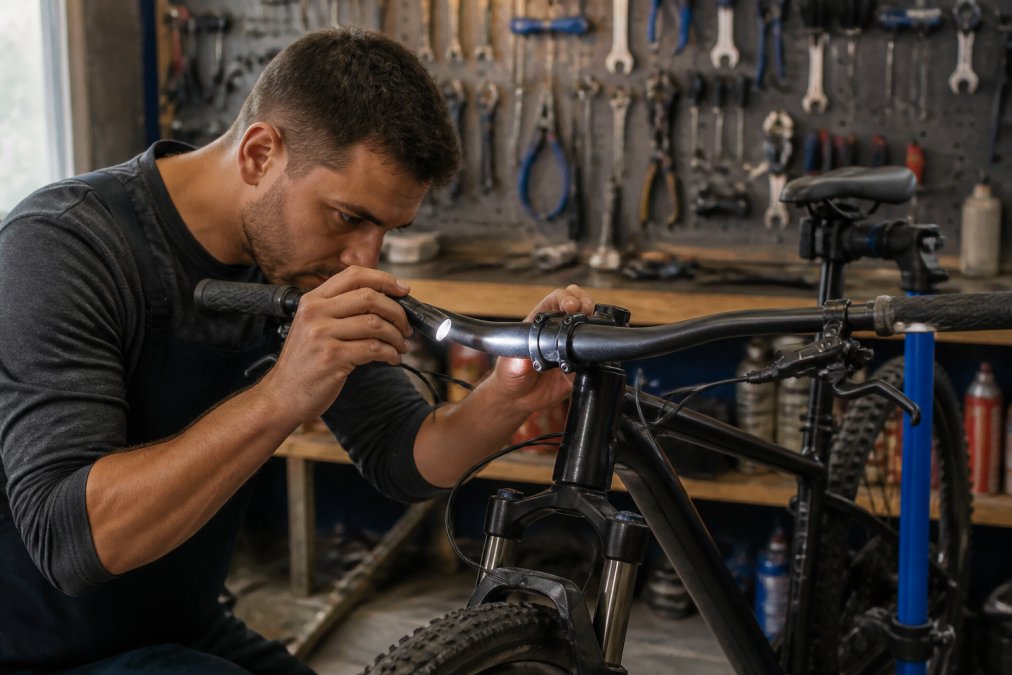
Inspection frequency. A reasonable baseline is every few months for casual riders, monthly for high-mileage riders, and always after a crash or a hard impact. Aluminum bars deserve more frequent checks than steel because they give less warning before failure.
What to look for on aluminum. Aluminum does not rust, so the failure signature is mechanical, not chemical:
- Hairline cracks radiating from the clamp edges, brake lever perches, or bar-end plugs. These often look like a faint scratch until you flex the bar.
- Dents and deep gouges that create a stress concentrator. A gouge deeper than roughly the thickness of a credit card is a reason to replace the bar, not to file it smooth.
- Creaking or ticking under load, especially when standing or sprinting. Creaking can be a loose stem bolt, but it can also be a crack propagating.
- White or chalky oxidation at the clamp, a sign of galvanic corrosion where aluminum meets a steel stem or bolt.
What to look for on steel. Steel fails differently. The dominant risk is corrosion, not fatigue:
- Surface rust that has pitted the metal. Light surface rust is cosmetic; pitting that has eaten into the wall thickness is not.
- Paint or powder-coat bubbling near the clamp or welds, rust is often working underneath.
- Cracks at welds on welded steel bars, particularly where the crossbar meets the main tube.
The cotton-ball test. Run a cotton ball along the bar surface. Snagged fibers catch on hairline cracks you cannot see by eye. It is a fast, cheap way to catch micro-fractures before they grow, and it works on both materials.
Replacement thresholds. Replace the bar immediately if you find any of the following: a visible crack of any length; a dent or gouge at the clamp; a bar that has been through a significant crash; or a bar that has exceeded the manufacturer's stated service life. When in doubt, replace. A handlebar is one of the cheapest safety-critical components on a bike, and a failure at speed is not survivable in the way a flat tire is.
Material-specific takeaway. Steel bars reward occasional inspection with long service. Aluminum bars demand regular inspection because their failure mode is sudden. Neither is maintenance-free, but the inspection habit is the same: clean, light, flex, look, and replace when in doubt.
Cost, Maintenance, and Environmental Impact
Steel handlebars usually cost less up front and last longer, which lowers long-term replacement costs. Alloy bars cost more to replace over time but save weight every ride. The environmental impact tilts toward steel as well: steel is highly recyclable, and a bar that lasts decades produces less waste than one replaced every few seasons.
Maintenance differs too. Steel needs its coating intact to prevent oxidation and rust. Alloy resists corrosion naturally but demands regular crack inspection because of metal fatigue. Neither is maintenance-free.
| Factor | Steel | Aluminum Alloy |
|---|---|---|
| Upfront cost | Lower | Moderate |
| Replacement frequency | Low | Higher |
| Corrosion care | Coating upkeep | Minimal |
| Recyclability | High | High |
| Inspection need | Occasional | Regular |
For riders who want set-and-forget durability, steel wins. For riders chasing performance and low weight, alloy is worth the extra attention.
Conclusion
Choosing between alloy and steel comes down to what you value most: the light, stiff feel of alloy or the long fatigue life of steel. Neither is universally better, but both demand attention to material fatigue and regular inspection.
Health and Fitness Company builds gear for riders who take durability seriously. Our Alloy Bicycle Handlebar pairs a lightweight alloy build with rubber lock-on grips for comfort and control, and it is priced to make upgrading easy. Get started with Health and Fitness Company and ride with a handlebar engineered for the long haul.
Frequently Asked Questions
Which is better, aluminum or steel handlebars?
Neither is universally better; it depends on your priorities. Alloy (aluminum) handlebars are lighter and stiffer, making them ideal for performance riding and mountain biking. Steel handlebars are heavier but more ductile, meaning they bend before breaking and can absorb vibration better. For most recreational riders, alloy offers the best balance of weight, cost, and durability. Steel remains a solid choice for heavy-duty or vintage builds where comfort and crash tolerance matter more than weight.
Do alloy handlebars fatigue faster than steel?
Alloy handlebars can fatigue faster than steel because aluminum has no true fatigue limit; every stress cycle causes microscopic damage. Steel has an endurance limit, so below a certain stress level it can theoretically last forever. However, well-made alloy bars from reputable brands are designed to withstand years of normal riding. The key is avoiding overtightening and replacing bars after a major crash, as impact damage accelerates fatigue.
Why have steel handlebars become less common in modern cycling?
Steel handlebars have become less common because alloy and carbon fiber offer significant weight savings without sacrificing stiffness. A typical alloy bar weighs 250-300 grams, while a steel bar can weigh 500 grams or more. That weight penalty affects acceleration and handling. Alloy also resists corrosion better when painted or anodized. However, steel still appears on budget bikes, touring setups, and vintage restorations where durability and comfort outweigh weight concerns.
How does weight affect the durability of handlebars?
Weight itself doesn't directly determine durability, but it influences how stresses are distributed. Heavier steel bars often have thicker walls, which can resist bending and impact better. Lighter alloy bars use thinner walls and rely on alloy composition and heat treatment for strength. A lighter bar isn't automatically weaker, but it may be less forgiving after a crash. Always follow torque specs and inspect for micro-fractures, especially on lightweight alloy models.